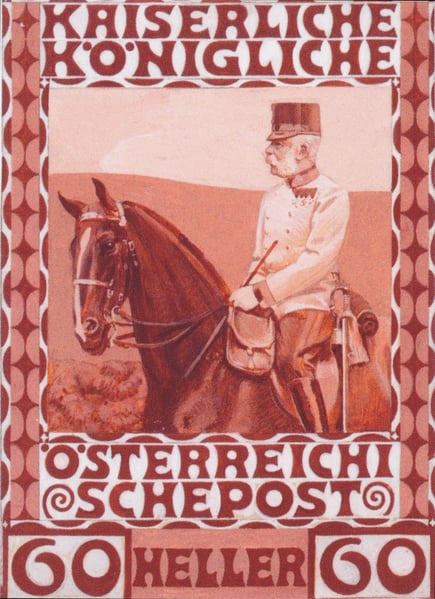
Design of the anniversary stamp with Austrian Franz Joseph I. on horseback
Details
Expert analysis of Koloman Moser’s Design of the anniversary stamp with Austrian Franz Joseph I. on horseback
Style: Art Nouveau (Modern) · Genre: design
This expert analysis focuses on the significance of Koloman Moser’s Design of the anniversary stamp with Austrian Franz Joseph I. on horseback within the context of Art Nouveau (Modern) design.
Artwork: Design of the anniversary stamp with Austrian Franz Joseph I. on horseback
Artist: Koloman Moser
Style: Art Nouveau (Modern)
Genre: Design
Expert Analysis
Koloman Moser’s stamp design transforms a traditional royal portrait into a sophisticated exercise in graphic modernity, marking a pivotal moment where political iconography meets the decorative principles of the Vienna Secession. As a founding member of the Wiener Werkstätte, Moser was instrumental in elevating applied arts—including stamp design—to the level of fine art.
1. Integration of Symbol and Ornament
Moser abandons the literal, weighty realism typical of 19th-century imperial imagery. Instead, he reduces the figure of Emperor Franz Joseph I on horseback to a clean, stylized silhouette that emphasizes dynamic line over volume. The horse and rider are contained within a decorative frame or medallion, typical of Art Nouveau’s preference for whiplash curves and symmetrical geometry. The result is a stamp that functions both as official currency and as a miniature poster—an object of everyday beauty.
2. Modern Graphic Language
The design demonstrates Moser’s mastery of negative space and typography integration. Letters and numbers are not superimposed clumsily but become part of the overall ornamental rhythm. This reflects the Secessionist belief in Gesamtkunstwerk (total work of art), where every element—image, letter, border—contributes to a unified aesthetic experience. The stamp’s simplified forms anticipate the modernist poster and logo design that would flourish in the early 20th century.
3. Political Image in a New Aesthetic
By depicting Franz Joseph I in a stylized, almost mythic equestrian pose, Moser simultaneously honors the emperor and distances the image from stale academic portraiture. The stamp becomes a symbol of the Austro-Hungarian Empire filtered through a progressive, forward-looking lens—a delicate balance between tradition and innovation that defines much of the Vienna Secession’s output.
4. Significance Within Art Nouveau
This work exemplifies how Art Nouveau designers approached functional objects—postage stamps, banknotes, posters—with the same seriousness as paintings or sculptures. Moser’s design is significant because it proves that even a tiny, mass-produced object could embody the movement’s core ideals: elegance of line, rhythmic composition, and the fusion of art with everyday life. It remains a key example of how graphic design emerged as a modern discipline from the crucible of Art Nouveau.
Visually similar
20 works with related composition and palette
The General at the River
Henri de Toulouse-Lautrec
A Dragoon on Horseback
Otto Bache
Soldat zu Pferd
Johann Daniel Holz
To The Grand Army of the Republic (Our Old Commander, General U. S. Grant)
Currier and Ives
2° Régiment De Carabiniers - Chef D'escadron
Carle Vernet
Part of a Series Chronicling the Uniforms of Napoleon's Grande Armée.
Carle Vernet
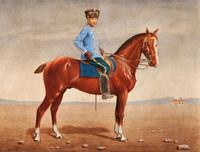
Portrait of Ludwig Blankenhorn as First Lieutenant
Georg Scholz
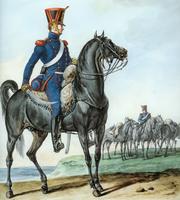
Part of a Series Chronicling the Uniforms of Napoleon's Grande Armée.
Carle Vernet
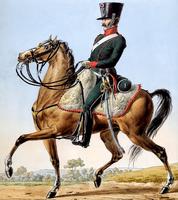
1st Regiment of Chasseurs À Cheval. Part of a Series Chronicling the Uniforms of Napoleon's Grande Armée.
Carle Vernet
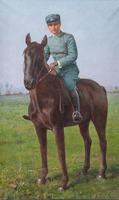
Ritratto Di Attilio Triboletti
Pasquale Celommi
Part of a Series Chronicling the Uniforms of Napoleon's Grande Armée.
Carle Vernet
1st Regiment of Dragoons - Colonel. Part of a Series Chronicling the Uniforms of Napoleon's Grande Armée.
Carle Vernet
Cuirassier à cheval
Edmond-Georges Grandjean
General Baquedano
Pedro Subercaseaux
Portrait of First Lieutenant Theodor von Klein on horseback
Albrecht Adam
ARMEE D'EGYP
Gustave Bourgain
Officier Des Dragons De La Garde Impériale En Grande Tenue
Carle Vernet
Portrait of Prince Felix Yussupov
Valentin Serov
Reiterporträt
Wilhelm Trübner
Part of a Series Chronicling the Uniforms of Napoleon's Grande Armée.
Carle Vernet