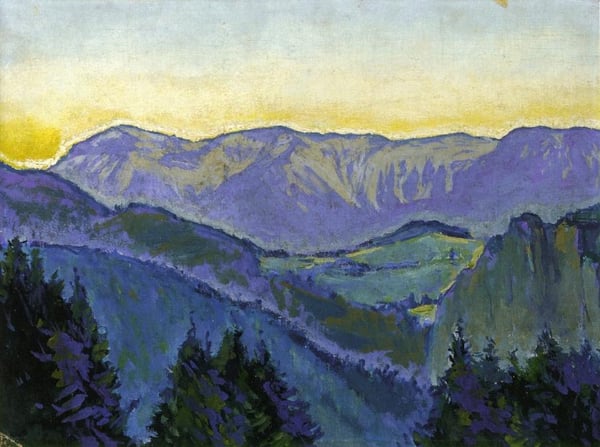
Koloman Moser sanatçısının Semmering Landscape eseri hakkında uzman analizi
Tarz: Symbolism · Tür: landscape
Expert Analysis of "Semmering Landscape" by Koloman Moser
Within the context of Symbolism, Koloman Moser’s Semmering Landscape transcends mere topographical representation. Unlike the naturalistic landscapes of Impressionism or the detailed realism of the preceding era, this work embodies the Symbolist pursuit of inner experience through external form. The landscape becomes a vessel for mood and metaphysical resonance, rather than a faithful depiction of a specific location.
Significance within Symbolism and the Landscape Genre
-
Emotional Transfiguration of Nature: The Semmering region of Austria, while a real alpine locale, is here transformed into a symbolic stage. Moser likely distorts color, line, and spatial arrangement to evoke a sense of stillness, melancholy, or spiritual withdrawal—hallmarks of Symbolist landscape painting. The scene functions less as a “view” and more as a psychological state, inviting the viewer to contemplate the sublime or the ineffable.
-
Decorative and Graphic Sensibility: As a leading figure of the Vienna Secession, Moser regularly brought a graphic, patterned quality to his paintings. In this landscape, that tendency may appear in stylized trees, rhythmic undulations of terrain, or a flattened perspective that prioritizes symbolic order over naturalistic depth. This decorative approach aligns with Symbolism’s rejection of mere imitation in favor of idealized, aesthetic form.
-
Period Significance: Painted around the turn of the 20th century, Semmering Landscape reflects the broader Symbolist rebellion against materialism and positivism. By choosing a landscape—typically a genre of objective observation—and infusing it with subjective, symbolic meaning, Moser asserts that even the most familiar natural scenes can serve as mirrors of the soul. This work thus stands as a key example of how Symbolist artists repurposed traditional genres to explore the unseen, the dreamlike, and the eternal.
In sum, the artwork’s importance lies in its seamless fusion of the landscape genre with Symbolist ideals, demonstrating how the external world can be reshaped to convey internal truths—a defining ambition of the movement.
Museum / Gallery
Görsel olarak benzer
İlişkili kompozisyon ve renk paletine sahip 20 eser
Landscape in Semmering
Koloman Moser
Mountain ranges
Koloman Moser
From Le Grand Muveran Villars
Ferdinand Hodler
Lake Thun
Ferdinand Hodler
The Lady of the Isenfluh
Ferdinand Hodler
Grand Muveran
Ferdinand Hodler
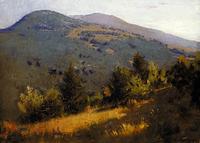
Spring Hillside
Abbott Handerson Thayer
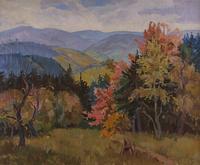
In the Foothills of the Carpathians
Adalbert Erdeli
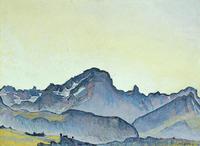
The Grand Muveran
Ferdinand Hodler
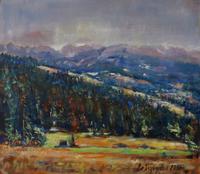
Widok na Tatry
Czesław Jan Pyrgies
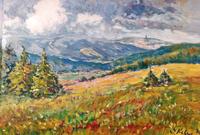
UNDER MOUNTAINS JESENIKY
JAROSLAV KELUC
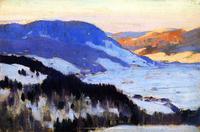
Overlooking the Valley of the Gouffre, Charlevoix
Clarence Gagnon
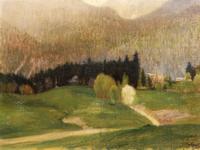
Landscape with Fir Trees
Konstantinos Parthenis
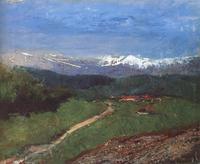
Landscape in the Alps (View from the Rax)
Laszlo Mednyanszky
UNDER MOUNTAINS JESENIKY
JAROSLAV KELUC
Landscape with small town
Cesare Tallone
La colline noire
Roderic O'Conor
Mount Kolsaas, Norway
Claude Monet
Landscape
Zinaida Serebriakova
Tulola
Nicholas Roerich