
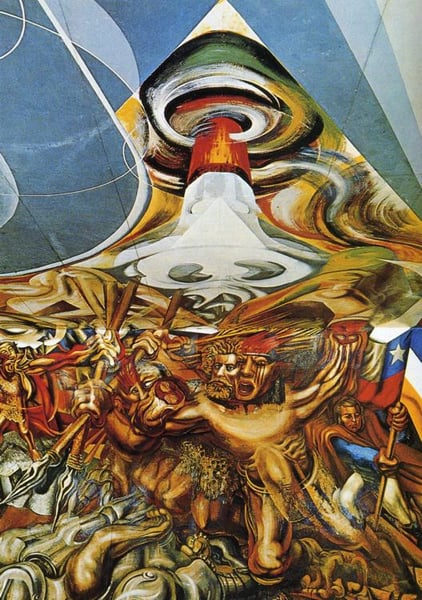
Expert analysis of David Alfaro Siqueiros’s Death to the Invader
Style: Muralism · Genre: allegorical painting
Expert Analysis of "Death to the Invader" by David Alfaro Siqueiros
David Alfaro Siqueiros’s “Death to the Invader” stands as a powerful exemplar of Mexican Muralism, a movement that transformed public art into a platform for radical social and political commentary. As an allegorical painting, the work transcends mere historical depiction to embody the ideological struggle against foreign domination—a central theme in Siqueiros’s oeuvre and in the broader Muralist movement.
Significance within Muralism:
Allegory in Muralism was often used to communicate complex narratives to a largely illiterate populace. Here, Siqueiros mobilizes the genre to deliver an unambiguous anti-imperialist message: the figure of Death, or perhaps a personification of revolutionary justice, is called upon to vanquish the invader. The title itself is a direct, almost battle-cry declaration, aligning with Muralism’s mission to fuse art with activism. Siqueiros, known for his militant stance and technical dynamism, likely employs dramatic foreshortening, diagonal thrusts, and powerful chiaroscuro—hallmarks of his style—to create a sense of urgent, unfolding conflict.
Artistic and Historical Significance:
First, the work exemplifies the Muralist principle of making art accessible to the public, typically on large-scale walls in government or civic buildings. By choosing an allegorical format, Siqueiros elevates a contemporary political necessity—resistance to invasion—into the realm of timeless myth, thereby giving historical weight to the fight for national sovereignty. Second, it reflects the artist’s own involvement in revolutionary politics: Siqueiros was an active communist and veteran of the Mexican Revolution, and his murals often envision the triumph of the oppressed over foreign and domestic exploiters. Third, the piece contributes to Muralism’s legacy of blending indigenous and European artistic traditions—here, the allegorical language of classical painting is repurposed for a distinctly Latin American struggle.
In summary, “Death to the Invader” is significant not only as a monumental work of public art but as a quintessential Siqueiros statement: fiercely political, formally inventive, and deeply rooted in the allegorical tradition of Muralism, where the battle for a just society is rendered as a grand, symbolic drama.
Visually similar
20 works with related composition and palette

Death to the Invader
David Alfaro Siqueiros
For Complete Social Security of All Mexicans
David Alfaro Siqueiros
Mural
David Alfaro Siqueiros
The Torment of Cuauhtemoc
David Alfaro Siqueiros
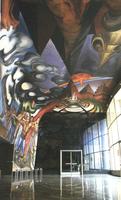
For the Complete Safety of all Mexicans on Work
David Alfaro Siqueiros
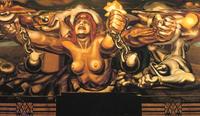
View of a mural depicting Democracy breaking her chains
David Alfaro Siqueiros
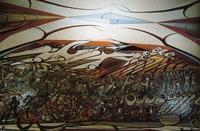
The March of Humanity
David Alfaro Siqueiros
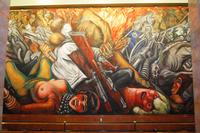
Catharsis
Jose Clemente Orozco

Mankind's Struggle for Lasting Peace (detail)
Vela Zanetti
Prometheus
Jose Clemente Orozco
The March of Humanity
David Alfaro Siqueiros

The great mexican revolutionary law and the freedom of slaves
Jose Clemente Orozco
Omniciencia
Jose Clemente Orozco
The Contribution of the Negro to Democracy in America
Charles Wilbert White

Man Seeking Peace
Vela Zanetti
The Revolution (mural)
David Alfaro Siqueiros
Ceiling of Colegio de San Ildefonso
Jose Clemente Orozco

The Clowns of War Arguing in Hell
Jose Clemente Orozco
Filipino Struggles Through History
Botong Francisco
Panel 6. Pre Columbian Golden Age - The Epic of American Civilization
Jose Clemente Orozco