Expertenanalyse zu Andre Derains The Last Supper of Jesus
Stil: Cubism · Genre: religious painting
Expert Analysis of "The Last Supper of Jesus" by André Derain
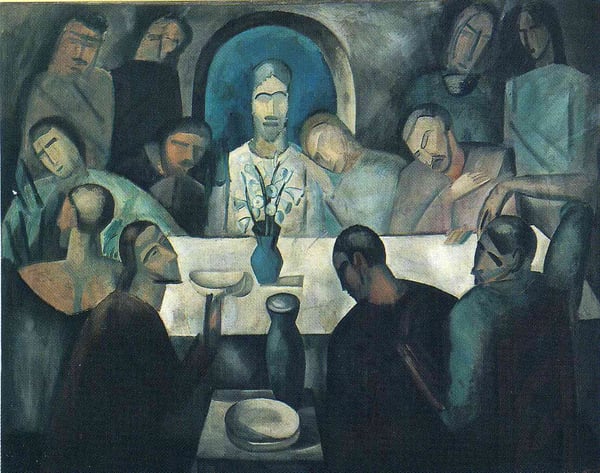
André Derain’s The Last Supper of Jesus is a significant work that merges the revolutionary visual language of Cubism with the deeply traditional genre of religious painting. Created during a period when Derain moved beyond his earlier Fauvist experiments, this piece exemplifies how Cubist principles—fragmentation, multiple perspectives, and geometric abstraction—could be applied to a sacred narrative.
Significance within Cubism and Religious Art
-
Recontextualizing a Sacred Subject
Cubism, primarily associated with still lifes, portraits, and urban scenes, rarely tackled explicitly religious themes. Derain’s treatment of the Last Supper—a cornerstone of Christian iconography—was audacious. By deconstructing the classical composition (typically arranged with Christ at center and apostles in a linear frieze), Derain replaced narrative clarity with a dynamic arrangement of faceted planes and interlocking forms. The viewer is forced to reassemble the familiar scene from abstracted clues, such as the suggestion of a table, chalice, and halo-like shapes. -
Synthesis of Tradition and Modernity
The painting reflects Cubism’s ambition to see objects from multiple angles simultaneously. Here, Derain applies that logic to a moment of profound spiritual weight. The traditional empathy of the scene (Christ’s announcement of betrayal) gives way to a formalist exploration of space and structure. This juxtaposition challenges the viewer to find meaning not in literal representation but in the tension between recognizable symbols and their abstract presentation. -
Derain’s Position in Cubism
While Derain is best known as a Fauvist, his brief but important engagement with Cubism (circa 1910–1912) shows his versatility. The Last Supper demonstrates his ability to adopt a rigorous geometric vocabulary while retaining a sense of monumentality. Unlike the more cerebral Cubism of Picasso or Braque, Derain’s version often retains a tactile, almost sculptural quality—visible here in the dense, blocky forms that hint at volume.
Conclusion
The Last Supper of Jesus is significant for daring to place a canonical religious subject within the most avant-garde idiom of its time. It underscores Cubism’s potential to refresh even the most familiar narratives, while also marking Derain’s transitional phase—a moment when he tested the boundaries between abstraction and iconic representation. The work remains a compelling example of how early 20th-century artists wielded modernism to reimagine spiritual experience.
Museum / Gallery
Visuell ähnlich
20 Werke mit ähnlicher Komposition und Farbpalette
Untitled
Georg Pauli
Invocation
Max Weber
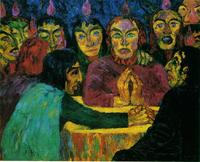
Pentecost
Emil Nolde
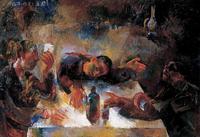
Drinkers (Wine Drinkers)
Vilmos Aba-Novak
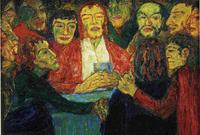
The Last Supper
Emil Nolde
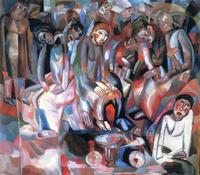
At the Table
Pavel Filonov
At the Table
Volodymyr Loboda
Easter
Pavel Filonov
The Shebeen, Sophiatown
Gerard Sekoto
The Three at the Table
Pavel Filonov
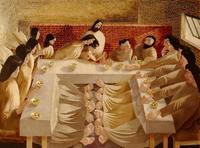
The Last Supper
Stanley Spencer
The meals
Andre Masson
Last supper
Oleg Holosiy
Les Pélerins d'Emmaus
Alfred Manessier
Чайхана
Александр Николаевич Волков
L'attesa
Felice Casorati
Танец
Александр Николаевич Волков
Call to Revolution and Table of Universal Brotherhood (Table of Universal Brotherhood)
Jose Clemente Orozco
Fisherman's Last Supper
Marsden Hartley
Cinque uomini al tavolo
Ottone Rosai