The Three at the Table
Expert analysis of Pavel Filonov’s The Three at the Table
Style: Analytical Realism · Genre: genre painting
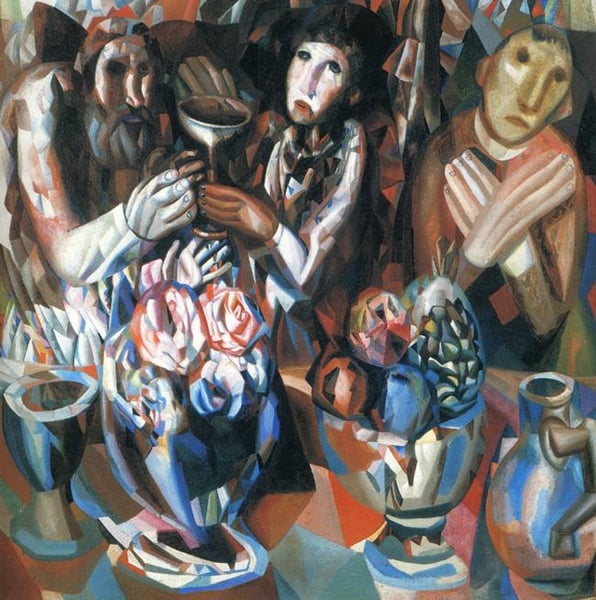
Pavel Filonov’s The Three at the Table is a quintessential demonstration of Analytical Realism, the artist’s own revolutionary method that sought to dissolve the boundaries between object, space, and energy. While the work belongs to the genre of everyday life—showing three figures seated around a table—Filonov transforms this seemingly mundane scene into a densely woven, almost microscopic universe.
Significance within Analytical Realism:
Filonov rejected both traditional naturalism and pure abstraction. Instead, he built his compositions from countless tiny, colored “atoms” or brushstrokes, each one recording a separate moment of perception. In The Three at the Table, every inch of the canvas is worked with obsessive intensity: faces, hands, tableware, and even the air between them are fractured into a vibrating network of facets. This technique embodies his core principle of “making the invisible visible”—not just the physical objects, but the psychological and temporal processes that shape them.
Genre painting reimagined:
Where conventional genre painting aims for anecdotal charm or social observation, Filonov’s version is almost claustrophobically analytical. The three figures are not individuals so much as nodes in a field of formal relations. The table becomes a fulcrum of intersecting lines and color rhythms. The result is a work that feels both primitive and hyper-modern—rooted in the Russian avant‑garde’s desire to see the world anew, yet uncompromising in its refusal to offer easy readability.
Legacy:
The Three at the Table stands as an extreme example of how an artist can push representation to its limits while remaining tethered to recognizable subject matter. It is a key work for understanding Filonov’s insistence on “organic” painting—the belief that a picture should grow like a living organism, cell by cell, rather than be composed from a pre‑set plan. In this way, it challenges viewers to slow down and inhabit the act of seeing itself, making the ordinary extraordinary through sheer pictorial density.
Genre
Style
Visually similar
20 works with related composition and palette
At the Table
Pavel Filonov
Pouring
Robert Delaunay
The meals
Andre Masson
Танец
Александр Николаевич Волков
Les Pélerins d'Emmaus
Alfred Manessier
Harlequin leaning
Pablo Picasso
Men at Bar
Kenneth Baker
Daudet
Bela Czobel
Still Life after de Heem's 'La Desserte'
Henri Matisse
The antigraceful
Umberto Boccioni
The Last Supper of Jesus
Andre Derain
Lee and his sister Hoetger
Paula Modersohn-Becker
Woman in a Café: Compenetrations of Lights and Planes
Umberto Boccioni
Homage to Still Life
Carlos Almaraz
Game
Volodymyr Loboda
El sueno de Dona Marina 2
Alberto Gironella
Vase, Bottle and Fruit
Henri Matisse
Fantasy
Evan Magar
Still Life with Vase, Bottle and Fruit
Henri Matisse
Memorando I
Gil Teixeira Lopes