Analisi esperta di For the love potion di Mikhail Nesterov
Stile: Symbolism · Genere: genre painting
Expert Analysis of "For the love potion" by Mikhail Nesterov
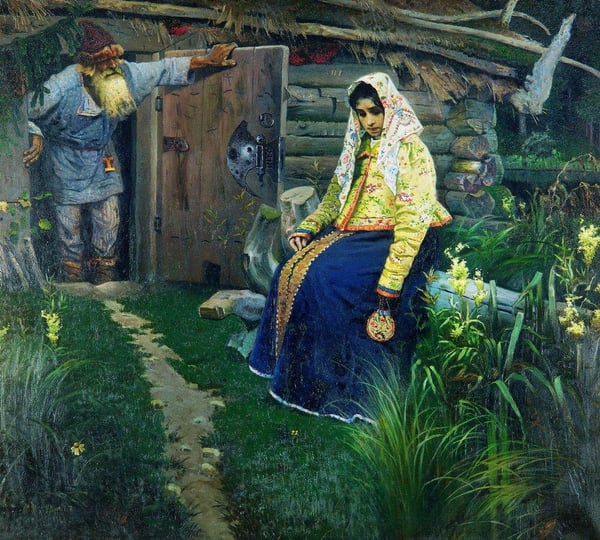
Mikhail Nesterov’s For the love potion stands as a compelling example of Russian Symbolism, a movement that prioritized spiritual longing and inner emotion over literal representation. As a genre painting—typically a scene of everyday life—Nesterov subverts the ordinary by infusing it with mystical, otherworldly significance. The title itself points to ritual and folk magic, themes that resonate deeply with the Symbolist fascination with the occult, medieval lore, and the search for transcendent meaning.
Significance within Symbolism and Genre Painting:
-
Transformation of the Mundane: Unlike realist genre works that document daily existence, Nesterov uses the familiar setting (likely a rustic interior or secluded glade) as a stage for the symbolic. The act of preparing a love potion elevates a domestic or peasant activity into a sacred, almost liturgical moment. This blending of the concrete and the abstract is a hallmark of Symbolist genre painting—it suggests that profound mysteries hide beneath life’s surface.
-
Russian Spiritual Heritage: Nesterov often explored themes of faith, monasticism, and folk tradition. Here, the love potion ties to pre-Christian Slavic beliefs and the lingering presence of paganism in rural life. By choosing such a subject, he aligns Symbolism with national identity, creating a visual poetry that speaks to timeless human desires—love, fate, and the supernatural.
-
Atmosphere and Mood: Symbolists prioritized mood over narrative. The implied stillness, the focus on process (mixing the potion), and the hushed, expectant atmosphere would likely be rendered with muted colors and soft, diffused light. This deliberate vagueness invites the viewer to contemplate the unseen forces at play, making the painting as much about the spiritual weight of the moment as about the literal act.
-
Rejection of Modernity: Like many Symbolists, Nesterov turned away from industrialization and contemporary life. By depicting a world where love is secured through magical means, he champions an older, more intuitive worldview—one where nature, emotion, and ritual hold power.
Conclusion: For the love potion is significant precisely because it marries the accessible format of genre painting with the elevated, introspective aims of Symbolism. It demonstrates that the deepest truths can be found not in grand historical or mythological scenes, but in the quiet, charged rituals of ordinary people. Nesterov thus expands the possibilities of both genre and symbol, creating a work that resonates as a meditation on human longing and the perennial quest for connection beyond the material world.
Visivamente simili
20 opere con composizione e palette affini
Misery
Nikolay Bogdanov-Belsky
Knuckles
Vladimir Makovsky
In the Village
Andrei Ryabushkin
Everything In the Past
Vassily Maximov
In a Village. Going to Liturgy
Andrei Ryabushkin
To the son
Klavdy Lebedev
Prayer service at the farm in Ukraine. Sketch for the painting "Prayer at Easter"
Vladimir Makovsky
The bylinas narrator Nikita Bogdanov
Vasily Polenov
Thought
Mikhail Nesterov
Country Idyll
Henryk Siemiradzki
Easter Mass
Vladimir Makovsky
Peasant boys
Vladimir Makovsky
Send off of recruit
Ilya Repin
Christ blesses Bartholomew
Mikhail Nesterov
Girlish Bbq
Alexei Korzukhin
The first collective farmers. In the rays of of the sun. Podolina. Mosk. reg.
Konstantin Yuon
Larin Paraske
Albert Edelfelt
After the Market
Konstantin Makovsky
Portrait of the Ukrainian boy
Nikolai Ge
Village Holiday (Autumn holiday in the village)
Boris Kustodiev