Expertenanalyse zu Benozzo Gozzolis St. Augustine Departing for Milan
Stil: Early Renaissance · Genre: religious painting
Expert Analysis of St. Augustine Departing for Milan by Benozzo Gozzoli
Significance within the Early Renaissance
Benozzo Gozzoli’s St. Augustine Departing for Milan exemplifies the Early Renaissance shift from hieratic, iconic religious imagery toward narrative, human-centered storytelling. As a pupil of Fra Angelico, Gozzoli inherited a refined sense of luminous color and delicate detail, but he infused his works with a lively, almost worldly naturalism that distinguishes this piece. The painting’s significance lies in how it merges sacred subject matter with a keen observation of contemporary life, a hallmark of the period.
Composition and Narrative Clarity
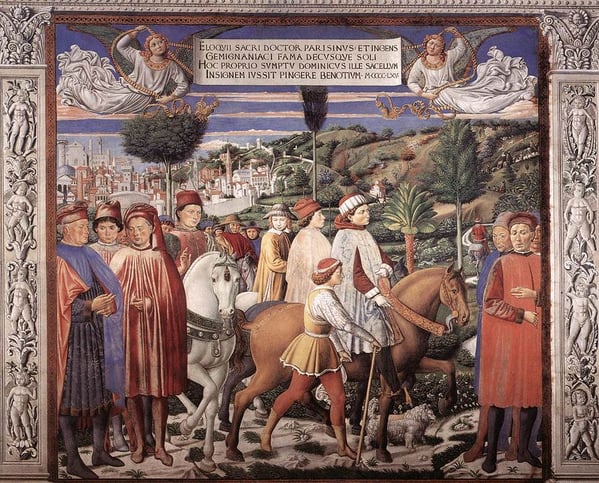
The scene captures the moment St. Augustine—the great theologian and Doctor of the Church—sets out for Milan, a pivotal journey that will lead to his conversion under St. Ambrose. Gozzoli uses a clear, sequential narrative: Augustine, often depicted in scholar’s robes or bishop’s vestments, is shown in the act of departure, accompanied by companions and domestic details that ground the holy event in tangible reality. This focus on a specific episode from Augustine’s life reflects the Early Renaissance interest in personal, human drama within biblical or hagiographic stories.
Use of Space and Perspective
True to the Early Renaissance pursuit of spatial coherence, Gozzoli organizes the composition with a strong sense of depth. The figures occupy a foreground stage, while the background opens onto a landscape—possibly a Tuscan hillside, rendered in soft greens and blues—that recedes into the distance. This integration of figure and landscape, though not yet mathematically rigorous in linear perspective, shows Gozzoli’s debt to Florentine innovations (e.g., Masaccio’s spatial cues) and his own decorative flair. The architecture framing the departure, perhaps a city gate or classical arch, anchors the scene in a credible, if idealized, world.
Color, Light, and Detail
Gozzoli’s palette is characteristically rich: warm golds, deep blues, and earthy reds dominate the clothing, while the sky glows with a soft, diffused light. His meticulous attention to texture—the sheen of silk, the roughness of stone, the foliage of trees—invests the painting with an almost miniature-like precision. Such detail was not mere ornament; it served to make the divine accessible, allowing viewers to recognize their own world in the sacred narrative. This is especially significant in Gozzoli’s oeuvre, as seen in his famous Journey of the Magi frescoes, where contemporary Florentine faces and fashions appear in biblical scenes.
Stylistic Synthesis
St. Augustine Departing for Milan bridges the Gothic tradition of elaborate, gold-ground devotional art and the High Renaissance’s classical monumentality. Gozzoli retains a decorative, tapestry-like richness, yet infuses the scene with a credible, airy landscape and naturalistic poses. The figures interact with gentle gestures, their expressions composed but engaged—a departure from the static, otherworldly icons of earlier centuries. This synthesis makes the painting significant as an example of how Early Renaissance artists humanized religious imagery without sacrificing its sacred gravity.
Conclusion
In this work, Gozzoli does not merely illustrate a saint’s journey; he creates a visual sermon on the intersection of the divine and the everyday. St. Augustine Departing for Milan stands as a testament to the Early Renaissance’s core achievement: making faith tangible through beauty, narrative, and a profound attention to the natural world. Its significance lies in its ability to transport the viewer into Augustine’s world, while inviting reflection on the spiritual journey that begins with a single step.
Museum / Gallery
Visuell ähnlich
20 Werke mit ähnlicher Komposition und Farbpalette
St. Augustine Departing for Milan
Benozzo Gozzoli
St. Augustine Departing for Milan (detail)
Benozzo Gozzoli
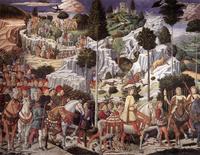
Procession of the Magus Balthazar (detail)
Benozzo Gozzoli
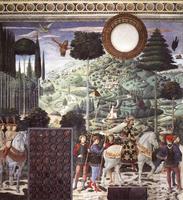
Procession of the Magus Melchior (detail)
Benozzo Gozzoli
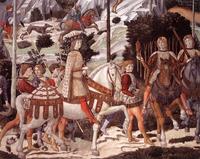
Procession of the Magus Balthazar (detail)
Benozzo Gozzoli
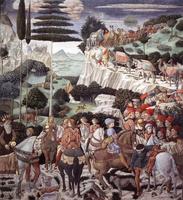
Procession of the Oldest King
Benozzo Gozzoli
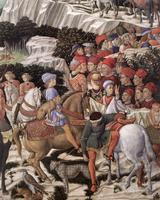
Procession of the Magus Caspar (detail)
Benozzo Gozzoli
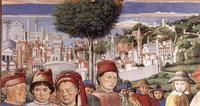
St. Augustine Departing for Milan (detail)
Benozzo Gozzoli
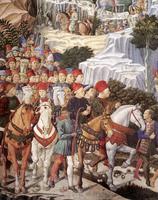
Procession of the Magus Balthazar (detail)
Benozzo Gozzoli
Procession of the Magi (detail)
Benozzo Gozzoli
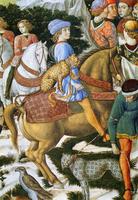
Portrait Of Giuliano De Medici. Procession of the Magus Caspar (detail)
Benozzo Gozzoli
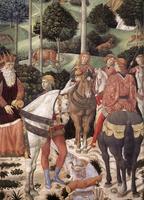
Procession of the Magus Caspar (detail)
Benozzo Gozzoli
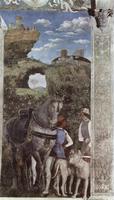
Horse and groom with hunting dogs, from the Camera degli Sposi or Camera Picta (detail)
Andrea Mantegna
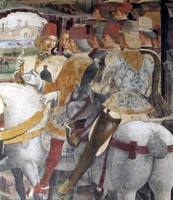
Allegory of March – Triumph of Minerva and Sign of Aries. Frescos in Palazzo Schifanoia (detail)
Francesco del Cossa
April. Fresco in Palazzo Schifanoia (detail)
Francesco del Cossa
Disembarkation at Ostia
Benozzo Gozzoli
The Martyrdom of St. James the Great
Jean Fouquet
The School of Tagaste
Benozzo Gozzoli
April. Fresco in Palazzo Schifanoia (detail) - Triumph of Venus
Francesco del Cossa
St. Augustine Reading the Epistle of St. Paul
Benozzo Gozzoli