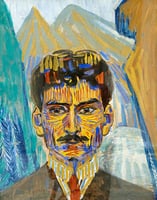
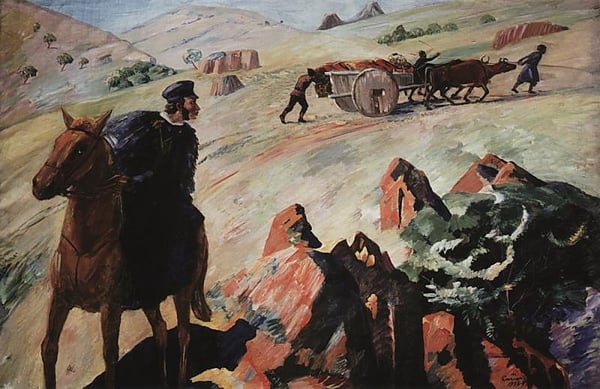
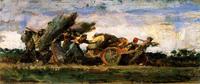
A meeting Pushkin with carriage, carrying the body of Griboyedov
Details
Expertenanalyse zu Martiros Sarians A meeting Pushkin with carriage, carrying the body of Griboyedov
Stil: Expressionism · Genre: genre painting
The work "A meeting Pushkin with carriage, carrying the body of Griboyedov" by Martiros Sarian is a striking example of how Expressionism can infuse a historical genre painting with profound emotional and symbolic weight. Though the supplied facts are limited to title, artist, style, and genre, its significance emerges from the intersections of those elements.
Subject and Historical Context: The painting depicts a moment from Russian literary history—the 1829 encounter between Alexander Pushkin and a carriage bearing the body of the poet and diplomat Alexander Griboyedov, who had been killed in Tehran. This meeting is a poignant touchpoint in Russian Romanticism, symbolizing the fragility of genius and the collision of life and death. Sarian, an Armenian artist working in the early 20th century, brings a distinctly personal and cultural lens to this Russian subject, linking Armenian, Persian, and Russian narratives.
Expressionist Treatment: As an Expressionist, Sarian prioritizes emotional intensity over naturalistic detail. The carriage, the figures (likely Pushkin and the driver), and the landscape are likely rendered with bold, distorted forms and vivid, non-naturalistic colors. This approach transforms a factual historical event into a universal meditation on loss, memory, and the mournful passage of time. The artist’s use of strong contrasts and rhythmic brushwork would amplify the sense of drama and melancholy, making the viewer feel the weight of the encounter rather than simply observe it.
Significance within its Period: Sarian’s work bridges Armenian modernism and Russian avant-garde art. By treating a canonical Russian literary scene with an Expressionist vocabulary, he challenges the boundaries of national narrative and genre painting. The painting becomes significant not only as a historical record but as a testament to how Expressionism can revitalize genre scenes, turning them into vessels for personal and collective emotion. The choice to depict a dead poet being carried through a landscape is also a profound reflection on the role of the artist in times of political turmoil (Griboyedov’s death was politically charged), resonating with early 20th-century anxieties about violence and creative sacrifice.
In summary, the artwork’s significance lies in its fusion of historical genre painting with Expressionist technique, producing a work that is both a memorial to two great Russian poets and a powerful statement on art’s ability to convey grief and transcend cultural specificity.
Visuell ähnlich
20 Werke mit ähnlicher Komposition und Farbpalette
Transport of the wounded (petroglyph)
August von Pettenkofen
Under escort. On the muddy road
Ilya Repin
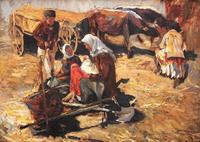
Countryside Life
Rudolf Schweitzer-Cumpana
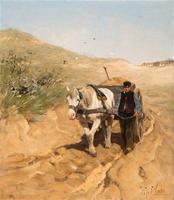
Farmer with horse and wagon in the dunes
Herman Johannes van der Weele
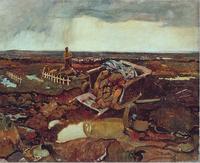
For What?
Frederick Varley
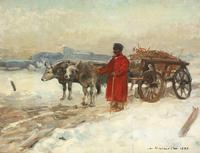
Halt
Nicolae Vermont
Mounted shepherd and cows
Giovanni Fattori
During Haying
Efim Volkov
Crossing of the River Oyat
Vasily Polenov
Hungarian market
August von Pettenkofen
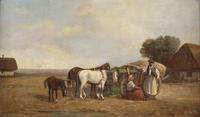
Hungarian Farmers with Wagon
August von Pettenkofen
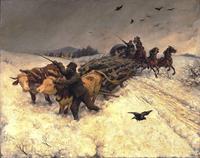
Sleigh ride
Rudolf Koller
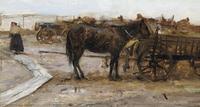
Horse Cards
August von Pettenkofen
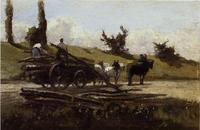
The Wood Cart
Camille Pissarro
Bivouac Russian soldiers
August von Pettenkofen
Fairground in Sinaia
Nicolae Grigorescu
Workers at Rest
Fernando Amorsolo
Wedding procession of troikas passing through the village
Sergei Semenovich Voroshilov
The bearers of bundles of twigs and twigs to burn
Cristiano Banti
In the mangel field
David Bates