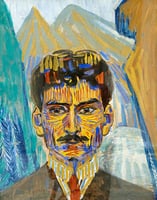
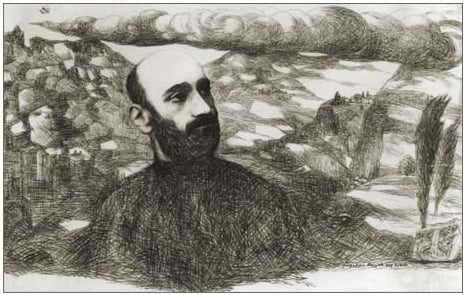
Analisi esperta di Komitas di Martiros Sarian
Stile: Expressionism · Genere: portrait
As an expert in art history, I offer the following analysis of "Komitas" by Martiros Sarian, based strictly on the provided facts.
Artwork Analysis: "Komitas" by Martiros Sarian
Style: Expressionism
Genre: Portrait
Significance within Expressionism and Portraiture:
Martiros Sarian’s "Komitas" is a masterful example of Expressionist portraiture, where the subject's inner psychological and spiritual state is prioritized over literal representation. The work’s significance lies in how Sarian employs the hallmarks of Expressionism—vivid, non-naturalistic color, distorted forms, and emotive brushwork—to transcend mere depiction of the famed Armenian composer and priest.
1. Emotional and Spiritual Revelation:
As an Expressionist portrait, the painting does not aim for photographic likeness but instead seeks to visualize Komitas’s profound inner world. Sarian captures the tragic duality of the subject: Komitas was both a towering figure in Armenian music and a victim of trauma (he suffered a mental breakdown after the Armenian Genocide). The expressive style allows Sarian to convey this psychological complexity—perhaps through jarring color contrasts or a weighty, somber palette—imbuing the portrait with a sense of melancholy, resilience, or spiritual depth.
2. Cultural and Symbolic Power:
Sarian, a leading Armenian modernist, consistently used Expressionist techniques to articulate national identity. By painting Komitas—a symbol of Armenian cultural heritage and suffering—Sarian transforms the portrait from a personal image into a national icon. The expressive distortions may emphasize features like the eyes or hands, highlighting Komitas’s role as a visionary artist and a wounded soul, thus merging personal tragedy with collective memory.
3. Break from Tradition:
In the context of portraiture, Sarian rejects academic realism. The expressive use of color (e.g., intense blues, fiery reds, or earthy browns) and simplified, angular forms prioritizes emotional impact over accuracy. This approach aligns with Expressionism’s goal to "express" rather than "represent," making the artwork a landmark in early 20th-century Armenian art, where Western European Expressionist techniques were adapted to local subjects with immense power.
Conclusion:
"Komitas" is significant because it exemplifies how Expressionism can transform a portrait into a profound psychological and cultural statement. Sarian’s work does not just show us what Komitas looked like; it makes us feel the weight of his genius and his tragedy, cementing the painting as a vital artifact of both art history and Armenian identity.
Visivamente simili
20 opere con composizione e palette affini
Tudor Vladimirescu
Theodor Aman
Giovanni Gabrielli, 'il Sivello'
Agostino Carracci
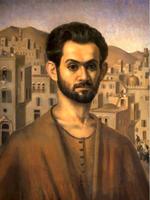
The Prophet (self Portrait)
Mahmoud Saiid
Maxime Gorki à mi-corps de face
Theophile Steinlen
Sultan Abdülaziz
Stanislaw Chlebowski
Head of a Young Man, Bareheaded
Vincent van Gogh
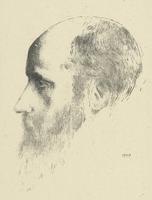
Édouard Vuillard
Odilon Redon
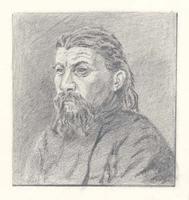
Priest from Gryzovo
Nicholas Roerich
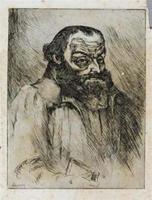
Primož Trubar
Matej Sternen
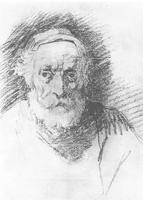
The old man's head
Orest Kiprensky
Rencontre
Theophile Steinlen
Portrait of the Abbot Sartori
Orest Kiprensky
Jean-Louis Greppo
Honore Daumier
Faust, Goethe's Tragedy
Eugene Delacroix
Self-Portrait
Georges Rouault
Self-portrait
Francesco Hayez
Jehan Rictus
Theophile Steinlen
Mikhail Ivanovich
Nicholas Roerich
Portrait of Philippe le Bon
Rogier van der Weyden
Cosimo de' Medici il Vecchio
Jacopo Pontormo