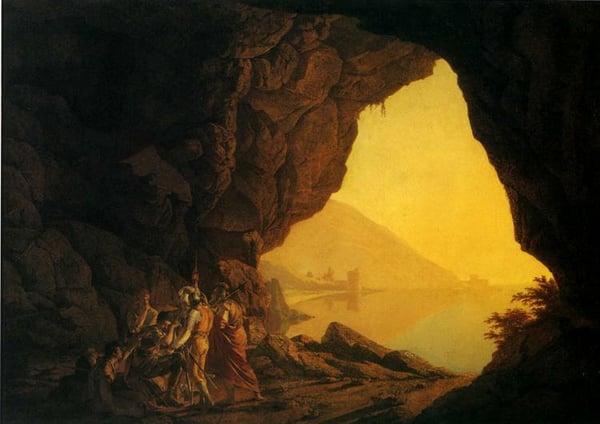
This work by Joseph Wright, a leading figure in British Romanticism, achieves significance through its masterful synthesis of the sublime landscape genre with the era’s fascination for the untamed and the dangerous. The painting’s title—A Grotto in the Kingdom of Naples, with Banditti—immediately signals two key Romantic preoccupations: the raw, dramatic power of nature (the grotto) and the human threat lurking within it (the banditti). Wright’s characteristic use of tenebrous lighting—a hallmark of his style drawn from earlier Baroque painting—dramatizes the cavern’s depths, creating a stark contrast between the shadowy interior and the luminous opening. This chiaroscuro not only heightens the sense of mystery and menace but also frames the banditti as figures at the edge of civilization, embodying the Romantic ideal of the outlaw existing outside societal norms. As a landscape, the grotto itself is a quintessentially Romantic subject: a natural formation that is both awe-inspiring and terrifying, inviting the viewer to contemplate the sublime power of the earth while acknowledging the very real danger that such wild places could harbor. Wright’s work stands out within Romanticism for its ability to merge topographical specificity (the Kingdom of Naples) with a universal, almost theatrical, anxiety about the unknown.