Expertenanalyse zu Joseph Wrights Lady Wilmot and Her Child
Stil: Baroque, Romanticism · Genre: portrait
Artwork Analysis: "Lady Wilmot and Her Child" by Joseph Wright
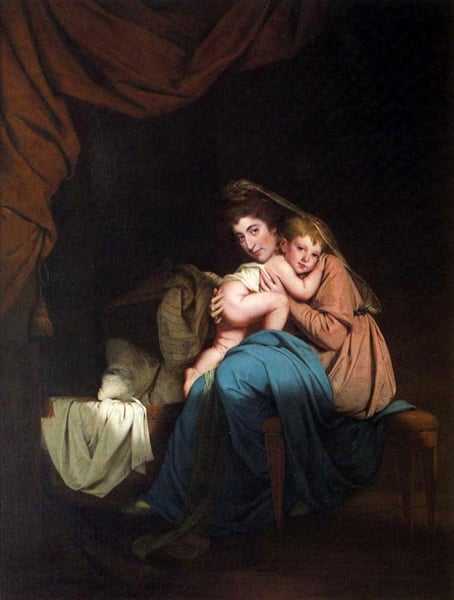
Joseph Wright of Derby, a master of the late 18th century, brings together two seemingly divergent stylistic currents—Baroque and Romanticism—in this intimate portrait of Lady Wilmot and Her Child. The work’s significance lies in its seamless fusion of Baroque theatricality with Romantic emotional depth, transforming a conventional mother-and-child portrait into a moving study of maternal tenderness and human connection.
Baroque Elements: Wright employs dramatic chiaroscuro, a hallmark of Baroque painting, to sculpt the figures against a dark, undefined background. The light falls selectively on Lady Wilmot’s face and hands and on the child’s delicate features, creating a sense of immediacy and intimacy. The diagonal composition—with the mother leaning forward, her body angled toward the child—echoes the dynamic, contrapposto arrangements of Baroque portraiture. This use of light and shadow not only adds volume and realism but also imbues the scene with a quiet, almost sacred gravitas, reminiscent of Caravaggio’s tenebrism.
Romantic Innovations: Yet Wright transcends Baroque formalism by infusing the portrait with the Romantic era’s emphasis on emotion and natural affection. Instead of presenting a stiff, hierarchical mother-child tableau (common in earlier aristocratic portraiture), he captures a fleeting, unguarded moment—perhaps the child reaching for its mother, or the mother’s gentle, absorbed glance. The soft, warm color palette and the luminous flesh tones suggest a personal, almost private bond, a departure from the didactic symbolism of Baroque allegory. The child is not a miniature adult but a vulnerable infant, and Lady Wilmot is portrayed not as a distant icon of motherhood but as a real, tender woman.
Significance in Context: Joseph Wright is best known for his candlelit scenes of scientific experiments and industrial subjects, but Lady Wilmot and Her Child demonstrates his equal mastery of the humane, domestic sphere. This portrait exemplifies the transition from the formal Baroque to the heartfelt Romantic, making it a bridge between 17th-century grandeur and 19th-century sensibility. It also reflects the rising value placed on familial intimacy in the Enlightenment and Romantic eras, where the private world of mothers and children became a worthy subject for high art. In its synthesis of dramatic lighting and sincere emotion, the work stands as a testament to Wright’s ability to elevate the portrait genre beyond mere likeness into a poetic meditation on love and life.
Museum / Gallery
Visuell ähnlich
20 Werke mit ähnlicher Komposition und Farbpalette
Virgin and Child
Titian
Virgin and Child
Bartolome Esteban Murillo
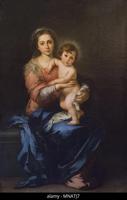
Virgin with Child
Bartolome Esteban Murillo
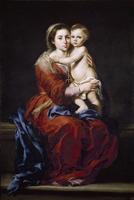
The Virgin of the Rosary
Bartolome Esteban Murillo
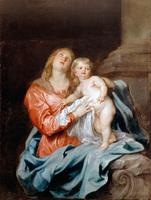
The Madonna and Child
Anthony van Dyck
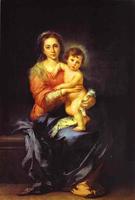
Madonna and Child
Bartolome Esteban Murillo
Virgin and Child
Bartolome Esteban Murillo
Madonna and Child
Bartolome Esteban Murillo
Madonna of the Apple
Francisco de Zurbaran
Portrait of Johanna De Geer with Her Two Children Cecilia and Laurens Trip as Caritas
Ferdinand Bol
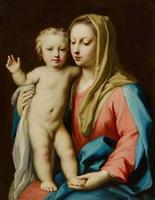
Virgin and Child
Jacopo Amigoni
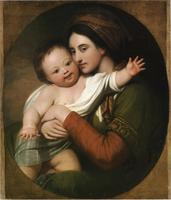
Mrs. Benjamin West and Her Son Raphael
Benjamin West
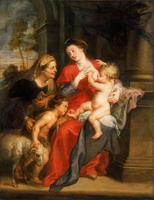
The Virgin and Child with Sts Elizabeth and John the BaptisT
Peter Paul Rubens
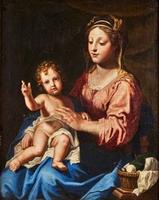
The Virgin and Child
Jacques Stella
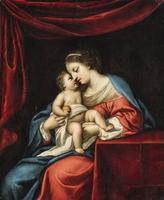
Virgin and Child holding an apple
Jacques Stella
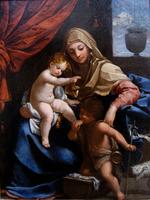
Madonna with Child and St. John the Baptist
Guido Reni
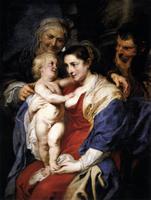
The Holy Family with St. Anne
Peter Paul Rubens
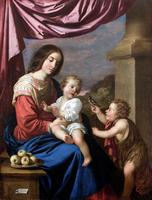
Virgin And Child With Saint John
Francisco de Zurbaran
Virgin with a Child
Francesco de' Rossi (Francesco Salviati), "Cecchino"
Madonna
Theodor van Thulen