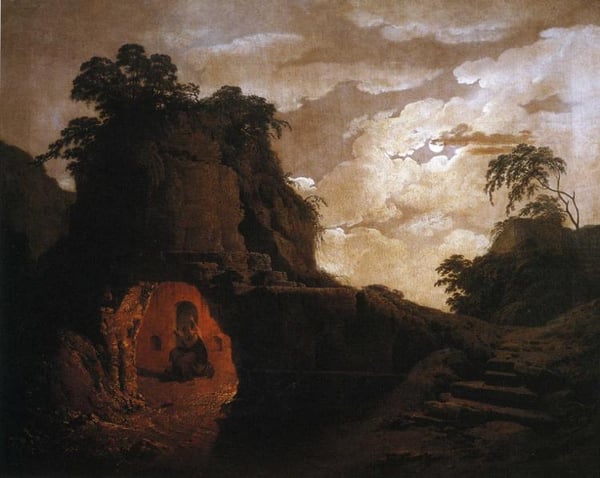
Virgil's Tomb, with the Figure of Silius Italicus
Dettagli
Analisi esperta di Virgil's Tomb, with the Figure of Silius Italicus di Joseph Wright
Stile: Romanticism · Genere: landscape
Expert Analysis: "Virgil's Tomb, with the Figure of Silius Italicus" by Joseph Wright (Romanticism, Landscape)
This work stands as a quintessential example of Romantic landscape painting, where the natural world becomes a stage for profound human emotion and historical reflection. Joseph Wright of Derby, celebrated for his mastery of chiaroscuro and his ability to infuse scenes with dramatic psychological tension, here turns his eye to the classical past and the sublime power of decay.
Significance within Romanticism:
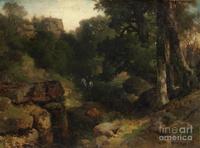
The painting directly engages with the Romantic fascination with ruins, mortality, and the passage of time. The tomb of the poet Virgil—a site of immense literary and cultural reverence—is depicted not as a pristine monument, but as a weathered, mossy structure overtaken by nature. This is the Romantic memento mori: a visual meditation on the transience of even the greatest human achievements. The figure of Silius Italicus, a Roman poet who actually owned the tomb, adds a meta-narrative layer. His presence as a contemplative observer draws the viewer into a dialogue with history, inviting us to reflect on our own place in the continuum of time.
Artistic Technique and Sublime Atmosphere:
Wright’s signature use of dramatic, often nocturnal light is central to the painting’s emotional impact. The soft, pale glow of the moon or twilight filters through the scene, casting long shadows and selectively illuminating the tomb’s broken forms. This chiaroscuro creates a brooding, melancholic stillness that is both serene and awe-inspiring—a hallmark of the Romantic sublime. The landscape itself is not merely a backdrop; it is an active participant, with gnarled trees and rugged terrain emphasizing the overwhelming power of nature over human artifice. The composition leads the eye from the solitary figure toward the tomb, then upward into the darkening sky, evoking a sense of spiritual contemplation.
Historical and Cultural Resonance:
By choosing Virgil’s tomb and linking it to Silius Italicus, Wright connects his Romantic-era audience to a lost classical world, yet he does so through a modern lens of emotional introspection. The painting is significant for its synthesis of history painting and landscape: it is a landscape that tells a story, weighted with literary and philosophical meaning. In the context of Wright’s oeuvre, this work bridges his famous scientific and industrial scenes (like An Experiment on a Bird in the Air Pump) and his later, more overtly sentimental landscapes, solidifying his role as a pioneer of Romanticism in British art. Ultimately, Virgil’s Tomb is not just a depiction of a place; it is a poignant meditation on legacy, memory, and the sublime beauty of decay.
Museum / Gallery
Visivamente simili
20 opere con composizione e palette affini

Virgil's Tomb
Joseph Wright

Grotto with Cascades
Salvator Rosa

Promeneurs et ermite devant une cascade
Michael Wutky
Landscape with ruins
Jacob van Ruisdael

The Evening Hunter
Thomas Moran

Lake with Castle on a Hill
Joseph Wright

Indian Sacrifice
Thomas Cole

Caledonia
Thomas Moran

The Trapper's Camp
Albert Bierstadt
Dovedale by Moonlight
Joseph Wright

Moonlit Landscape
Albert Bierstadt

On the Sweetwater Near the Devil's Gate, Nebraska
Albert Bierstadt

Expulsion from the Garden of Eden
Thomas Cole

A mountainous river landscape with figures on a track
Daniël Dupré

Romantic Landscape with Ruined Tower
Thomas Cole
On the Pontine swamps
Arnold Böcklin
Liensfiord, Norway: Calm
Francis Danby
Campfire Site, Yosemite
Albert Bierstadt
Evening mood on the Rhine (Koblenz)
Albert Flamm
The Dell
Thomas Moran