Olexandr Archipenko の Blue Dancer の専門的な分析
スタイル:Cubism · ジャンル:sculpture
Expert Analysis: "Blue Dancer" by Olexandr Archipenko
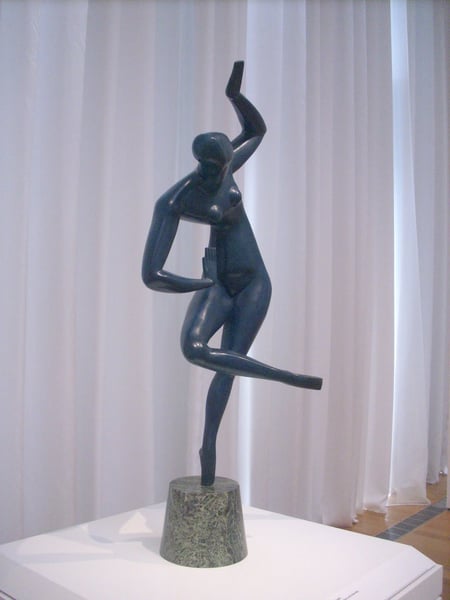
As a landmark of Cubist sculpture, Olexandr Archipenko’s Blue Dancer (often dated to the early 1910s) redefines the very language of three-dimensional form. While the supplied facts are limited to artist, title, style, and genre, we can locate its significance through the prism of Archipenko’s revolutionary approach to Cubism.
1. The Fusion of Color and Sculpture
Unlike traditional monochrome marble or bronze, Archipenko here introduces vivid polychromy—specifically, the titular blue. In the context of Cubist sculpture, this was radical. Where painters like Picasso and Braque had already used muted earth tones and collaged materials, Archipenko transferred the idea of color as a structural, not merely decorative, element into sculpture. The blue does not simply coat the surface; it defines spatial recesses, emphasizes volumes, and creates a rhythmic visual tension that echoes the fractured planes of Cubist painting.
2. The Embrace of Negative Space
Archipenko was a pioneer of “sculpto-painting,” but more importantly, he exploited void as a positive formal element. In Blue Dancer, hollows and concave shapes are as active as the convex masses—a direct sculptural translation of Cubism’s simultaneous viewpoints. The dancer’s body is not a continuous volume; it is a constellation of interlocking planes and empty intervals, suggesting motion and energy without resorting to naturalistic musculature.
3. Kinetic Abstraction within Cubist Principles
The title implies a figure in motion, yet the work denies any single frozen pose. Archipenko synthesizes multiple angles—profile, three-quarter, front—into one compact, rhythmic silhouette. This is Cubism’s signature “simultaneity” applied to sculpture, but with a distinctive grace: the angled limbs and rotating torso feel like a dynamic spiral, a dance rendered abstract but still legible through the interplay of positive and negative forms.
Significance within Cubism and Sculpture
Blue Dancer stands as a crucial bridge between Analytical Cubism’s fragmentation and later Synthetic Cubism’s bold color and construction. Archipenko’s use of polychrome initiated a debate about color’s role in sculpture that would influence Futurists, Constructivists, and Art Deco sculptors. Most critically, he proved that sculpture need not be monolithic or representational—it could be a transparent, faceted, and colored construction of space and movement. This work remains a touchstone for how Cubism liberated sculpture from mass and gravity, turning the dancer into a luminous, abstract rhythm of blue light and shadow.
視覚的に類似
構図やパレットが近い作品 20 件
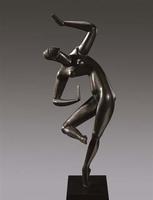
Blue dancer
Olexandr Archipenko
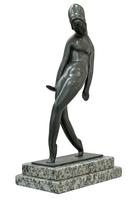
Bailarina
Victor Brecheret

Woman Combing her Hair
Olexandr Archipenko
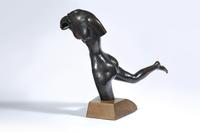
Flux (The Runner)
Leon Underwood
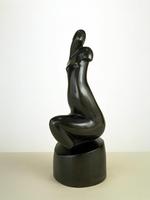
Seated Female Nude (Black Torso)
Olexandr Archipenko
Julia
Victor Brecheret
Sc01204c
ambrosio paolo
Untitled
Bahman Mohasses
Herald of New Day
Leon Underwood
Torso
Olexandr Archipenko

The Prophet Jeremiah
Harold Lehman
Femme allongée
Anton Prinner

Odile
MAUREEN QUIN

Maureen Quinn Sculpture - ODILE
MAUREEN QUIN
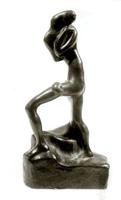
Woman Nude
Dimitrie Paciurea
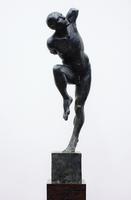
Transcendência Imanente
Giancarlo Avantaggiato
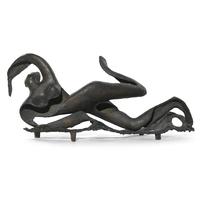
Water-Rhythm
Leon Underwood
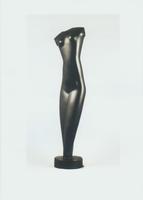
Torso
Olexandr Archipenko

Maureen the Teacher
MAUREEN QUIN

Maureen Vivian Quin
MAUREEN QUIN