Analisi esperta di Danse Macabre (Group Terror #41) di Olexandr Archipenko
Stile: Cubism · Genere: figurative
Expert Analysis: "Danse Macabre (Group Terror #41)" by Olexandr Archipenko
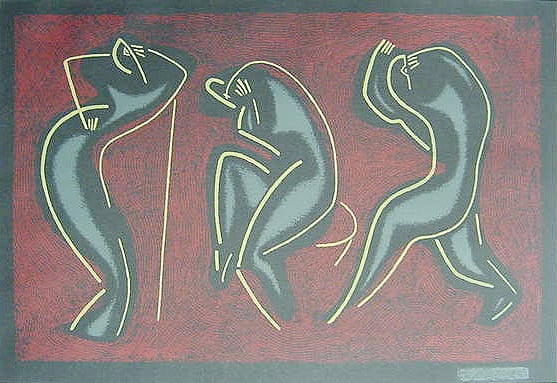
Olexandr Archipenko’s Danse Macabre (Group Terror #41) stands as a pivotal example of Cubist sculpture’s radical reimagining of the human figure. While traditional sculpture relies on solid mass and continuity, Archipenko introduces the Cubist vocabulary of fragmented planes, shifting perspectives, and, most critically, the use of negative space as an active compositional element. This work belongs to his Group Terror series, where he explores themes of existential dread and collective anxiety—here given a macabre, dance-of-death inflection.
Significance within Cubism and Figurative Art:
-
Sculpting the Invisible – Archipenko translates Cubist painting’s simultaneous viewpoints into three dimensions. In Danse Macabre, concave voids and angular projections replace traditional anatomical volume, forcing the viewer to move around the piece to assemble the figure from dynamic, fractured facets. The “dance” becomes a kinetic experience of form and absence.
-
Psychological Modernism – The title evokes the medieval danse macabre, but Archipenko updates it for the modern age of mechanized terror and urban alienation. The figure is neither coherent nor heroic; it is an angular, disquieting silhouette that embodies the fragmentation of the self under modern pressure—a theme resonant with post-World War I European anxiety.
-
Pioneering Materiality – Archipenko was among the first to incorporate polychrome and mixed materials into Cubist sculpture. While the specific materials of this piece are not noted here, his practice often combined bronze, concrete, or painted surfaces, challenging the monochrome tradition. The “terror” is thus also aesthetic: a jarring, discontinuous surface that refuses classical finish.
-
Genre Reimagined – Even within a figurative genre, Danse Macabre pushes toward abstraction without losing its human reference. The “group” aspect (implied by the series number) suggests a multiplicity of terrified bodies compressed into a single, convulsive form—a Cubist crowd rendered as a single sculptural syntax.
In summary, Danse Macabre (Group Terror #41) is a landmark of Cubist sculpture because it weaponizes formal fragmentation to express modern psychological terror, while expanding sculpture’s vocabulary through space, color, and discontinuous mass. Archipenko here achieves what few of his contemporaries did: making the static figure embody motion, multiplicity, and dread simultaneously.
Visivamente simili
20 opere con composizione e palette affini
Rock Art Figures
Walter Battiss
The Dance
Henri Matisse
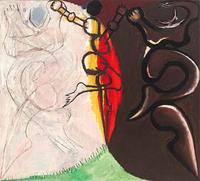
Dance IV
Frank Lobdell
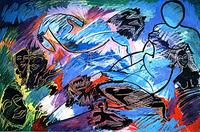
Yesterday Torture
Houria Niati
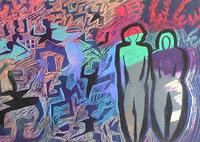
The Story of M and D
Houria Niati
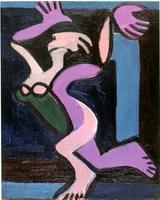
Dancing Female Nude, Gret Palucca
Ernst Ludwig Kirchner
Two Dancers
Christian Rohlfs
Music
Dorrit Black
Matraguna (section)
Mihai Olos
The Naughty Hill Carnival
Houria Niati
Study of Women
Ossip Zadkine
Erotic
Yiannis Moralis
Composition III
Nikos Nikolaou
Composition
Nikos Nikolaou
Soccer Field
Willi Baumeister
Summer (In Memory of James Budd Dixon)
Frank Lobdell
The Luncheon on the Grass
Pablo Picasso
Nude with Drapery (Study for "The great dancer")
Pablo Picasso
The messengers of the Day
Ossip Zadkine
Composition IIII
Nikos Nikolaou