Expertenanalyse zu Olexandr Archipenkos Nude
Stil: Cubism · Genre: nude painting (nu)
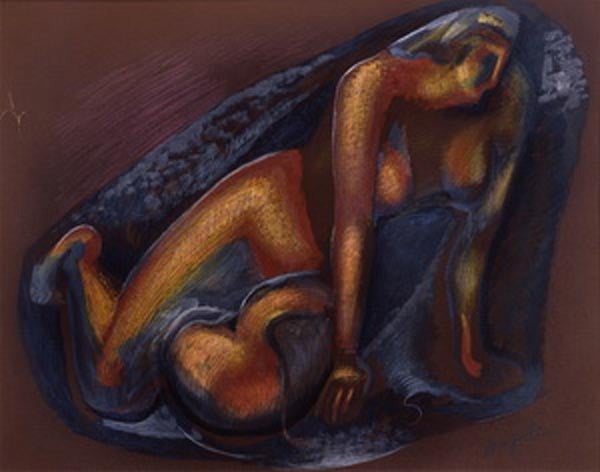
Artwork Analysis: "Nude" by Olexandr Archipenko (Cubism, c. 1910s)
Olexandr Archipenko’s “Nude” stands as a pivotal work within Cubist painting, distinguished by the artist’s unique fusion of sculptural thinking with painterly abstraction. While Archipenko is celebrated primarily as a sculptor—credited with introducing concave and convex forms into modern sculpture—this painting exemplifies how he transferred those spatial innovations onto a two-dimensional surface, redefining the traditional nude genre.
Stylistic Significance
True to Cubist principles, Archipenko fractures the female figure into a mosaic of interlocking geometric planes. Yet unlike the more analytical, monochromatic approach of Picasso or Braque, Archipenko injects a dynamic volumetric quality: he uses contrasting curves, angled facets, and a subtle interplay of light and shadow to imply three-dimensional mass. The figure is not merely flattened or deconstructed; it is re-constructed as a series of convex and concave “shapes,” echoing the hollows and protrusions of his sculptures.
Innovative Use of Negative Space
A hallmark of Archipenko’s work is the treatment of empty space as an active compositional element. In “Nude,” voids around and within the body—such as between the arm and torso—are given positive form, creating a rhythmic dialogue between solid and void. This “negative space” becomes a sculptural absence, challenging the viewer to perceive the figure as both object and environment.
Genre Transformation
By applying Cubist fragmentation to the traditional nude, Archipenko subverts classical ideals of harmonious proportions and sensual naturalism. Instead of a passive, idealized body, his “Nude” is an energetic assembly of angular volumes, alluding to the primal geometry of the human form. This work bridges the gap between painting and sculpture, anticipating later developments in Constructivism and the integration of space into modernist art.
Legacy
Archipenko’s “Nude” is significant not only as a Cubist painting but as a manifesto of his belief that “the sculpture of the future will be a painting in space.” It demonstrates how the boundaries between mediums can dissolve, and how the nude—one of the most enduring subjects in Western art—can be radically reimagined through the language of modernism.
Visuell ähnlich
20 Werke mit ähnlicher Komposition und Farbpalette
Reclining Nude
Pablo Picasso
Angel Prayer
Jules Olitski
La Rousse
Constant Permeke
Lying naked woman
Pablo Picasso
Act
Istvan Molnar
Seated Nude
Olexandr Archipenko
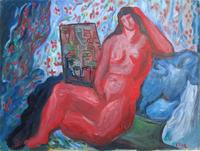
Red Figure
Sandro Chia
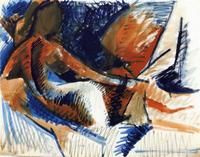
The Great Odalisque (after Ingres)
Pablo Picasso
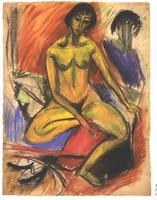
Seated Female Nude
Ernst Ludwig Kirchner
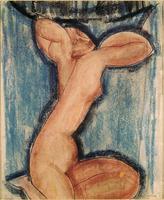
Caryatid
Amedeo Modigliani
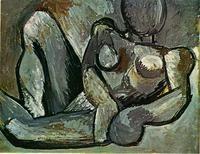
Reclining Nude
Pablo Picasso
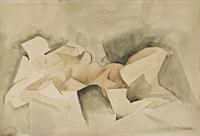
Nude
Emil Filla
Untitled
Graca Morais
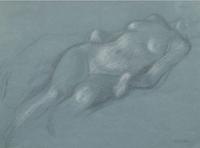
Reclining female nude
Theophile Steinlen
Reclining Nude
Ilya Mashkov
Sleeping
Biruta Baumane
Nude Seated with Arms Joined and Resting on a Support
Jules Olitski
Intimidades IV
Gil Teixeira Lopes
Dusk
Zoran Gizdić
Nude with book
Gazmend Freitag