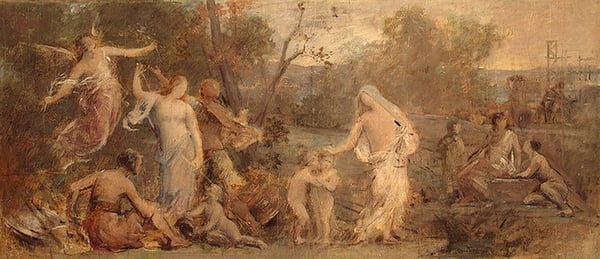
Allegory of Life
Expertenanalyse zu Pierre Puvis de Chavanness Allegory of Life
Stil: Symbolism · Genre: allegorical painting
Pierre Puvis de Chavannes’ Allegory of Life is a quintessential work of the Symbolist movement, a style that sought to convey ideas, emotions, and metaphysical concepts through evocative imagery rather than direct representation. As an allegorical painting, the piece uses symbolic figures and serene, monumental composition to explore universal themes of existence, transition, and the passage of time. Its significance lies in how Puvis de Chavannes distilled complex philosophical notions into a calm, timeless visual language—marked by simplified forms, muted palettes, and a dreamlike stillness—that influenced later Symbolists and even modernist painters. This work exemplifies the Symbolist desire to transcend the material world, inviting contemplation rather than narrative engagement, and thus stands as a key example of how allegory was revitalized in late 19th-century art.
Visuell ähnlich
20 Werke mit ähnlicher Komposition und Farbpalette
The Temptation of St. Anthony
Henri Fantin-Latour
The Judgment of Paris
Henri-Pierre Picou
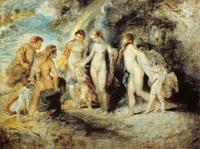
The Judgement of Paris
Peter Paul Rubens
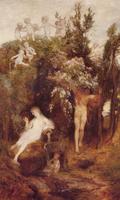
The Spring of Love
Arnold Böcklin
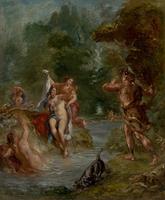
The Summer Diana Surprised by Actaeon
Eugene Delacroix
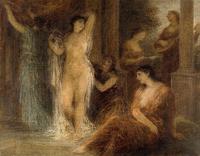
The Bath
Henri Fantin-Latour
“Satyre et nymphe avec amour dans un bois”,
Ker-Xavier Roussel
Diana and Her Handmaidens
Henri Fantin-Latour
Timon of Athens
Thomas Couture
Untitled
Henri Fantin-Latour
Hylas and the Nymphs
Karl Bryullov
Bathers I
Henri Fantin-Latour
The Sacred Wood Cherished by the Arts and the Muses (detail)
Pierre Puvis de Chavannes
Nymphs
Joan Brull
Idyll
Arnold Böcklin
The Three Graces
Peter Paul Rubens
The Blossoms of Spring (also known as Flora and Spring)
Louis Comfort Tiffany
Oreads
Eliseu Visconti
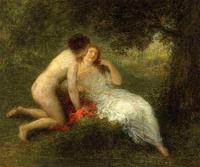
Bathers (also known as The Secret)
Henri Fantin-Latour
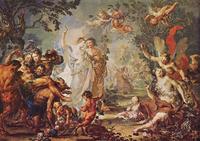
Allegory of the Four Seasons
Johann Georg Platzer