Bellum, War
Expert analysis of Pierre Puvis de Chavannes’s Bellum, War
Style: Symbolism · Genre: mythological painting
Expert Analysis: "Bellum, War" by Pierre Puvis de Chavannes
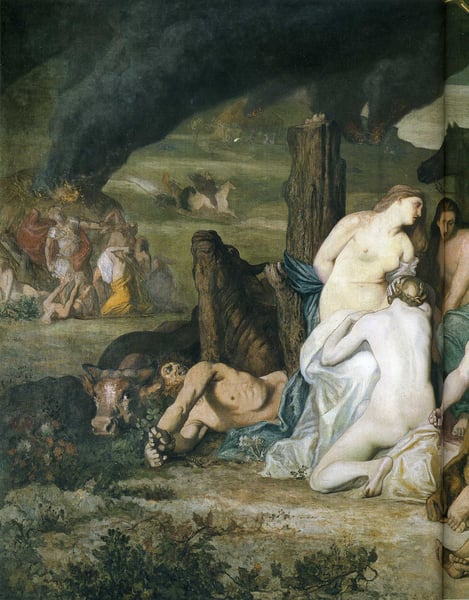
Pierre Puvis de Chavannes’ “Bellum, War” stands as a quintessential example of Symbolist painting, executed within the framework of mythological allegory. The work’s significance lies in its radical departure from the dramatic, violent realism typical of contemporary war imagery. Instead, Puvis de Chavannes employs a restrained, almost serene classical vocabulary to convey the abstract horror of conflict.
Stylistic Significance within Symbolism:
As a leading Symbolist, Puvis de Chavannes rejects narrative specificity in favor of timeless, universal themes. “Bellum” uses a frozen, frieze-like composition and muted earth tones to evoke a sense of solemn, eternal tragedy. The mythological genre allows him to strip war of its immediate historical context, transforming it into a symbolic meditation on suffering, fate, and the cyclical nature of human violence. The figures—often gaunt, passive, and arranged in spaced, hieratic groups—function as archetypal emblems rather than active participants, reinforcing the Symbolist interest in suggestion over description.
Influence and Legacy:
This painting is significant for its bridge between academic classicism and modernism. Puvis de Chavannes’ flattened pictorial space, simplified forms, and emphasis on mood over action prefigure the decorative abstraction of later artists like Maurice Denis and the Nabis. “Bellum” also anticipates the Symbolist turn inward, where the painting’s meaning resides not in the depicted event but in the emotional and intellectual resonance it evokes. By treating a mythologized war with the same quiet, monumental dignity as his scenes of peace, Puvis de Chavannes challenges the viewer to see war not as heroic spectacle but as a haunting, inescapable condition of humanity—a core tenet of Symbolist thought.
Visually similar
20 works with related composition and palette
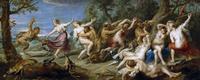
Diana and her Nymphs Surprised by the Fauns
Peter Paul Rubens
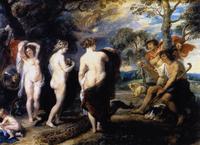
The Judgment of Paris
Peter Paul Rubens
Nymphs and Satyrs
Peter Paul Rubens
DIANA UND IHRE GESPIELINNEN BEIM BADE
Hans Rottenhammer I
Diana and Callisto
Titian
The Judgement of Paris
Peter Paul Rubens
The Bacchanal of the Andrians
Titian
Treated by the Muses
Jacob Jordaens
The Bacchanal of the Andrians
Peter Paul Rubens
Diana and Callisto
Peter Paul Rubens
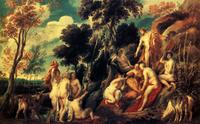
Pan punished by the Nymphs
Jacob Jordaens
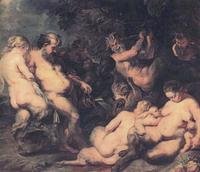
Bacchanale
Peter Paul Rubens
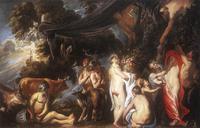
Allegory of Fertility
Jacob Jordaens
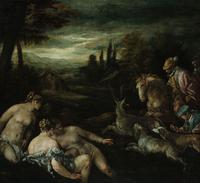
Diana and Actaeon
Jacopo Bassano
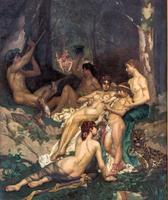
The Childhood of Bacchus
Charles Giron
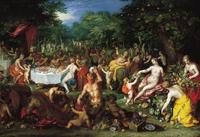
A Bacchanal
Jan Brueghel the Elder
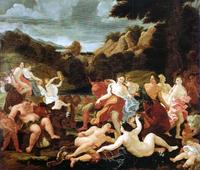
Triumph of Bacchus and Ariadne
Giovanni Battista Gaulli
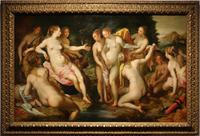
Diana discovers Callisto's Pregnancy
Hendrick Goltzius
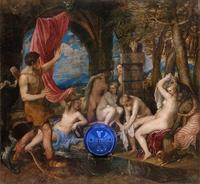
Gazing Ball (Titian Diana and Actaeon)
Jeff Koons
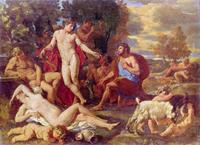
Midas and Bacchus
Nicolas Poussin