
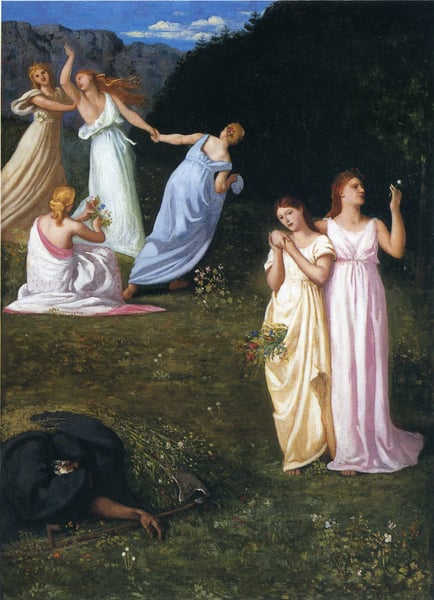
Expertenanalyse zu Pierre Puvis de Chavanness Death and the Maidens
Stil: Symbolism · Genre: allegorical painting
As an expert art historian, I will analyze "Death and the Maidens" by Pierre Puvis de Chavannes using only the structured facts provided: it belongs to the Symbolism style and is an allegorical painting.
Significance within Symbolism and Allegorical Tradition:
Pierre Puvis de Chavannes is a pivotal, often understated, figure within the Symbolist movement, and Death and the Maidens exemplifies what makes his contribution so distinctive. The painting's significance lies in how it redefines allegory for the Symbolist era.
-
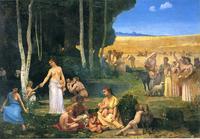
Reductive and Timeless Composition: Unlike the dramatic, detailed allegories of the Renaissance or Baroque periods, Puvis de Chavannes strips the scene down to its emotional and philosophical essence. The title directly references the Danse Macabre and Death and the Maiden motifs of earlier art, but here the encounter is not grotesque or theatrical. Instead, it is static, quiet, and introspective. This deliberate stillness—a hallmark of his style—forces the viewer to meditate on the universal theme rather than be distracted by narrative action.
-
Symbolist Mood over Morality: Traditional allegorical painting often carried a clear moral lesson (e.g., Vanitas). In this Symbolist work, the allegory is ambiguous and suggestive. The "Maidens" (plural) are not simply victims; they exist in a dreamlike, flattened space with the personification of Death. Puvis de Chavannes uses muted, pale colors—almost chalky—and simplified, sculptural forms. This creates a veil of melancholy and calm, inviting multiple interpretations: Is Death a release? A seducer? A natural, inevitable companion? The painting embodies the Symbolist goal of expressing an idea or emotion through form, not explicit narrative.
-
Influence on Modernism: Puvis de Chavannes's approach to allegory here—focusing on pure, monumental form and a restrained, lyrical palette—was revolutionary. He rejected the illusionistic depth and vivid storytelling favored by academic painting. Instead, Death and the Maidens presents a frieze-like, flat surface that anticipates the work of later Symbolists like Gauguin, and even the simplified forms of modernists like Matisse. Its significance is not just as an allegory of mortality, but as a bridge between 19th-century classicism and the symbolic, subjective art of the 20th century.
In summary, the painting is significant because it transforms a well-worn allegorical subject into a hushed, timeless Symbolist meditation, prioritizing mood, ambiguity, and formal purity over moralizing or dramatic action. It stands as a masterwork of Symbolist allegory, where the idea of "Death" and "Maiden" becomes a poetic, almost abstract, visual poem.
Museum / Gallery
Visuell ähnlich
20 Werke mit ähnlicher Komposition und Farbpalette
The Sacred Wood Cherished by the Arts and the Muses (detail)
Pierre Puvis de Chavannes
The Sacred Wood Cherished by the Arts and the Muses (detail)
Pierre Puvis de Chavannes
A Masque for the Four Seasons
Walter Crane
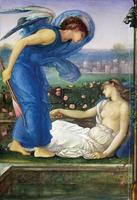
Cupid and Psyche
Edward Burne-Jones
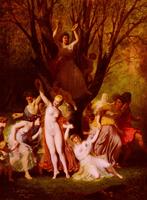
Ronde De Mai
Henri-Pierre Picou
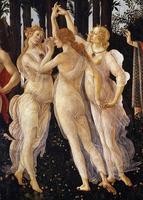
The Three Graces from Primavera
Sandro Botticelli
Finding Psyche
Edward Burne-Jones
The Feast of the Gods
Giovanni Bellini
Hymn to spring
Arnold Böcklin
Children in an Orchard
Pierre Puvis de Chavannes
Three Ladies Adorning a Herm of Hymen
Joshua Reynolds
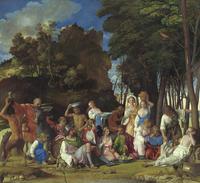
The Feast of the Gods
Giovanni Bellini
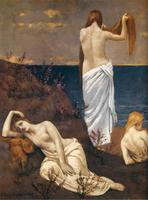
Young Girls by the Sea
Pierre Puvis de Chavannes
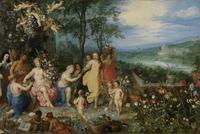
Der Frühling
Jan Brueghel the Elder
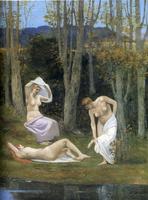
Summer
Pierre Puvis de Chavannes
The Feast of the Gods
Titian
Nymphs
Henri-Pierre Picou
Poème de l'âme 13: Rayons de soleil
Louis Janmot
Meditation
Pierre Puvis de Chavannes
Summer
Pierre Puvis de Chavannes