
Pierre Puvis de Chavannes sanatçısının Young Girls on the Edge of the Sea eseri hakkında uzman analizi
Tarz: Symbolism · Tür: nude painting (nu)
Expert Analysis: "Young Girls on the Edge of the Sea" by Pierre Puvis de Chavannes
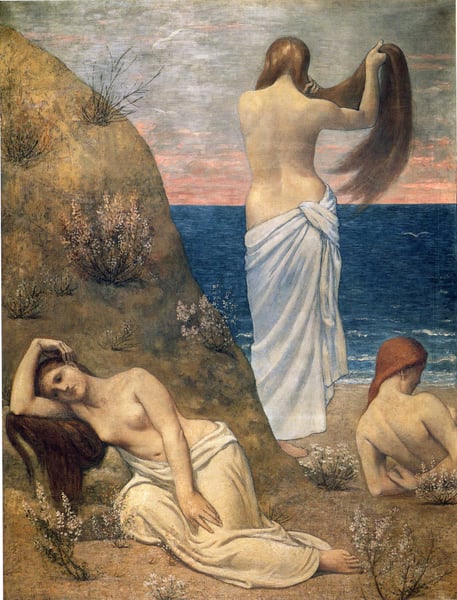
This work is a quintessential example of Symbolist painting, marking a deliberate departure from the naturalism and anecdotal narratives of Impressionism and academic realism. Puvis de Chavannes achieves significance through his radical simplification of form, subdued palette, and evocative, timeless atmosphere—all hallmarks of Symbolism's search for inner truth and poetic suggestion.
Composition and Stylization:
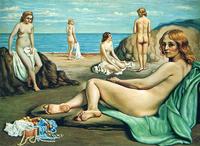
The painting presents three nude or seminude young women arranged in a frieze-like, almost archaic composition along a shoreline. The figures are not individualized portraits but archetypes: the seated figure in profile, the reclining dreamer, and the standing observer. Puvis flattens the pictorial space, using soft, muted earth tones (ochres, grays, pale blues) and eliminating strong chiaroscuro. This deliberate flattening, combined with the simplified, almost sculptural contour lines, evokes the frescoes of early Italian Renaissance and classical Greek vase painting. The sea, sky, and distant horizon are reduced to minimal, horizontal bands, creating a meditative stillness.
Symbolist Themes:
The title "Young Girls on the Edge of the Sea" is deceptively simple. For Symbolists, the edge—the shoreline—represents a liminal space between the material world and a transcendent, dreamlike realm. The sea itself often symbolizes the unconscious, infinity, or the passage of time. The girls' nudity is not erotic in a conventional sense; it is idealized, suggesting timeless purity, vulnerability, and a state of being before or beyond culture. Their poses (one withdrawn, one contemplating the horizon, one gazing outward) embody different modes of human consciousness—introspection, longing, and quiet observation. Puvis avoids any specific narrative, instead inviting the viewer to project a subjective, emotional response.
Significance within Symbolism and Nude Painting:
This work is significant for redefining the nude as a vehicle for symbolic, rather than mythological or literal, expression. Unlike academic nudes that relied on mythological or historical pretexts, Puvis's nudes are placeless and characterless, existing in a kind of eternal present. This anti-naturalistic quietude directly influenced later Symbolists (e.g., Maurice Denis, Paul Gauguin) and foreshadowed the simplified forms of modernism, particularly the Nabis and even Matisse's Luxe, calme et volupté.
Puvis de Chavannes also rejected the anecdotal sentimentalism of popular genre painting. Here, the mood is contemplative rather than dramatic, and the painting's power lies in its suggestion of a universal, melancholic beauty. "Young Girls on the Edge of the Sea" thus stands as a crucial bridge between 19th-century academic classicism and the emerging symbolic and modernist sensibilities—a serene, enigmatic vision that prioritizes feeling over fact.
Museum / Gallery
Görsel olarak benzer
İlişkili kompozisyon ve renk paletine sahip 20 eser
Young Girls by the Sea
Pierre Puvis de Chavannes
The Bathers
Pierre Puvis de Chavannes
Summer
Pierre Puvis de Chavannes
The Happy Land
Pierre Puvis de Chavannes
The Sacred Wood Cherished by the Arts and the Muses (detail)
Pierre Puvis de Chavannes
The Judgement of Paris
Paul Cezanne
Hope
Pierre Puvis de Chavannes
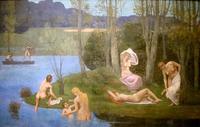
Summer
Pierre Puvis de Chavannes
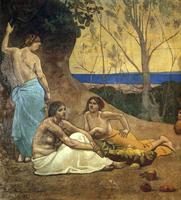
The Happy Land (detail)
Pierre Puvis de Chavannes
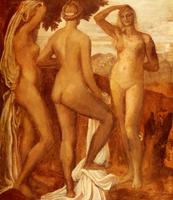
Judgement Of Paris
George Frederick Watts
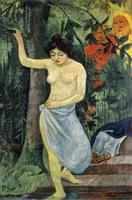
Susanna and the Elders
Paul Serusier
The Large Bathers
Pierre-Auguste Renoir
Hymn to spring
Arnold Böcklin
The Little Sea Maid
Evelyn De Morgan
Girl and boy picking flowers
Arnold Böcklin
The Four Seasons: Summer
Jean-Leon Gerome
The Penitent Magdalen
Pierre Puvis de Chavannes
Aphrodite, Appledore
Childe Hassam
Echo and Narcissus
John William Waterhouse
Bathers on the beach
Giorgio de Chirico