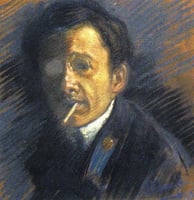
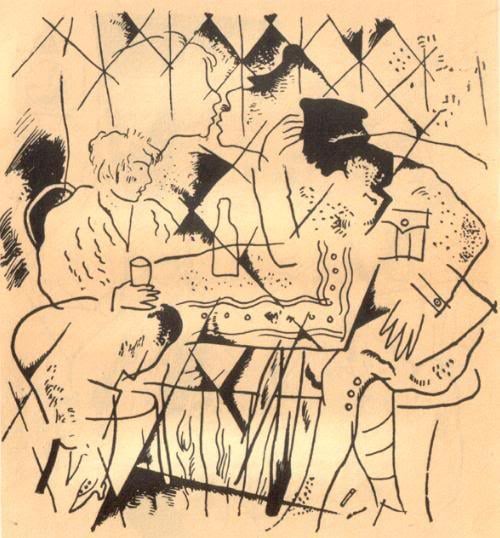
Illustration to Aleksander Blok's poem 'The Twelve'
Details
Expertenanalyse zu Jury Annenkovs Illustration to Aleksander Blok's poem 'The Twelve'
Stil: Expressionism · Genre: illustration
This artwork is a powerful example of Expressionist illustration from the early Soviet period, and its significance lies in how it translates the raw, revolutionary energy of Aleksander Blok’s iconic poem The Twelve into a visual language of distortion and emotion.
Contextual Significance:
Jury Annenkov created this illustration in the wake of the 1917 Russian Revolution, a time of immense social upheaval. Blok’s poem is a narrative of twelve Red Army soldiers marching through a blizzard, blending biblical imagery with street-level chaos. Annenkov’s illustration captures this tension not by depicting a literal scene, but by conjuring the poem’s psychological and atmospheric force.
Expressionist Characteristics:
The work exemplifies Expressionism through its deliberate rejection of naturalistic representation. Annenkov uses jagged, angular lines, exaggerated shadows, and a stark, high-contrast palette to convey the violence and disorientation of the era. The figures are distorted, their forms dissolving into the whirling snow—emphasizing the loss of individual identity amid the collective upheaval. This approach aligns with Expressionism’s goal to express inner emotional reality rather than outer appearances.
Genre and Innovation:
As an illustration, it goes beyond simply accompanying the text; it functions as a visual counterpoint, amplifying the poem’s fragmented rhythm. Annenkov pushes the boundaries of book illustration by treating the page as a dynamic, abstract field. The interplay of black and white shapes mimics the poem’s stark moral contrasts—faith versus chaos, order versus destruction.
Historical Importance:
This piece is a rare fusion of avant-garde visual art and revolutionary poetry. It represents a moment when Russian Expressionism (often overshadowed by Constructivism and Suprematism) provided a visceral, anti-idealistic lens for the revolution’s human cost. Annenkov’s work challenges the heroic, sanitized imagery of later Socialist Realism, retaining the raw, unresolved energy of 1918.
In summary, the artwork’s significance lies in its ability to make visible the tormented, ecstatic pulse of Blok’s poem, standing as a milestone in both Expressionist illustration and the visual documentation of the Russian Revolution.
Genre
Stil
Visuell ähnlich
20 Werke mit ähnlicher Komposition und Farbpalette
Café Chantant II
Ernst Ludwig Kirchner
Scene from Carnival
Spyros Vassiliou
Les Bleuets
Theophile Steinlen
Three Women in a Cafe
Ernst Ludwig Kirchner
sketch for The Conquest of the Air
Roger de La Fresnaye
In the café Rotonde
Marevna (Marie Vorobieff)
The celebrities: constellation
Otto Dix
Zwei Zigeunermädchen Im Wohnraum
Otto Mueller
Three Peasants at a Meal
Vincent van Gogh
The Patience
Georges Braque
At the Table
Volodymyr Loboda
Myslivci v hospodě
Josef Capek
Study for the Circus
Fernand Leger
Scheiber Hugó, Kávéházban
Scheiber Hugó
Le lecteur au bistrot
Gustave Buchet
Snobisme
Henri de Toulouse-Lautrec
Painter and Modell
Ernst Ludwig Kirchner
Las Meninas (Velazquez)
Pablo Picasso
Interieur d'un bar
Jean Hugo
Scheiber Hugó, Ellenfényben 1930
Scheiber Hugó