
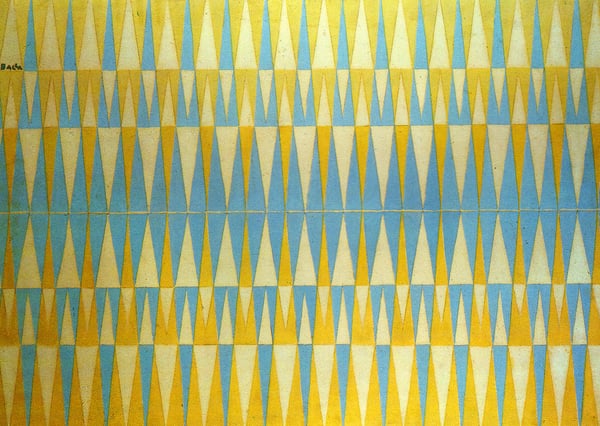
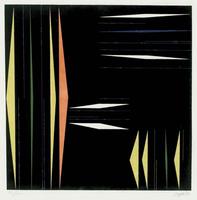
Iridescent Interpenetration No. 4 - Study of light
Details
Expert analysis of Giacomo Balla’s Iridescent Interpenetration No. 4 - Study of light
Style: Abstract Art · Genre: abstract
Artwork Analysis: "Iridescent Interpenetration No. 4 – Study of Light" by Giacomo Balla
Giacomo Balla’s "Iridescent Interpenetration No. 4 – Study of Light" is a landmark work in the transition from Futurist dynamism to pure abstraction. Though classified here under Abstract Art, its significance is rooted in Balla’s radical departure from representational forms—even the fragmented motion of his earlier Futurist paintings—toward a systematic exploration of color, light, and optical sensation itself.
What makes this work significant:
-
Pioneering chromatic abstraction: Balla created the Iridescent Interpenetration series around 1912–1914, predating many canonical abstract works. He focused on the perceptual interplay of complementary colors, arranging them in repeating, overlapping triangular or diamond-shaped fields. In this study, layers of luminous hues seem to vibrate against one another, creating an effect of shifting light without any reference to objects or perspective.
-
Scientific approach to color theory: The title explicitly links the work to optics. Balla was fascinated by the “iridescence” seen in nature (e.g., soap bubbles, oil on water) and sought to translate that fleeting, spectral quality into paint. He used the principle of simultaneous contrast—placing complementary colors side by side to make each appear more intense—thus producing a sense of radiant energy that engages the viewer’s retina directly.
-
Bridge from Futurism to abstraction: While the Italian Futurists celebrated speed, technology, and motion, Balla’s later experiments with pure light and color moved beyond depicting movement to embodying it through color interaction. This work shows how he abandoned recognizable subject matter (even the “interpenetrating” lines of dynamic shapes) to focus entirely on the sensation of light as a subject in its own right—a crucial step toward the non-objective art that would define much of 20th-century modernism.
-
Immediate visual impact: The composition is deceptively simple: a grid-like arrangement of intersecting, faceted forms, each filled with a different hue. Yet the painted surface seems to pulse and shift. Balla achieved this by applying paint in small, separate strokes or patches, allowing the colors to mix optically rather than physically—a technique that anticipates Pointillism’s optical blending but with a heightened, almost electric intensity.
In summary, "Iridescent Interpenetration No. 4 – Study of Light" is significant as a radical, scientifically informed experiment that dissolves the boundary between painting and pure optical experience. It stands as a key document of how one Futurist visionary helped lay the groundwork for abstract art, transforming the brushstroke into a vehicle for light itself.
Museum / Gallery
Visually similar
20 works with related composition and palette
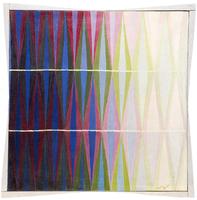
Iridescent Interpenetration No.7
Giacomo Balla
Mobile-Static M 0 27
Walter Leblanc
Structure triangulaire gris-brun
Guido Molinari
Untitled
Max Bill
Untitled
Myron Stout
Iridescent Interpenetration No.5 - Eucalyptus
Giacomo Balla
Tinta automotiva sobre madeira
Ivan Serpa
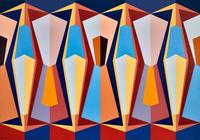
Stage II
Karl Benjamin
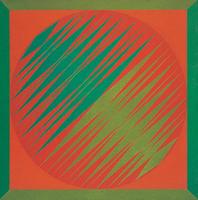
Série Amazônica nº 2
Ivan Serpa
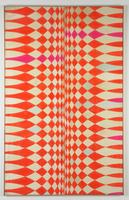
Pair Impair
Manfred Kuttner
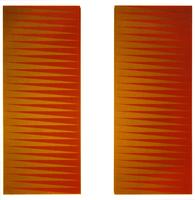
Echo
Leo Valledor
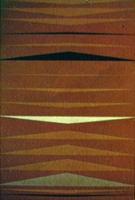
Faixas Ritmadas
Ivan Serpa
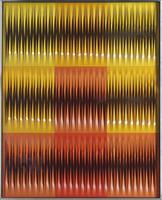
Torsions 40F.90
Walter Leblanc
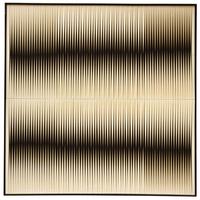
Torsions Mobilo-Static - Weiss auf Schwarz
Walter Leblanc
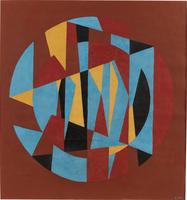
Viaje En Círculos Imaginarios
Sandu Darie
Breve
Jean Degottex
to Vuillard (Red and Green)
Joyce Kozloff
Torsions Mobilo-Static
Walter Leblanc
Cite
Ellsworth Kelly
Composição
Ivan Serpa