Iridescent Interpenetration No.7
Details
Expert analysis of Giacomo Balla’s Iridescent Interpenetration No.7
Style: Abstract Art · Genre: abstract
Expert Analysis: Iridescent Interpenetration No.7 (c. 1914–1918) by Giacomo Balla
Significance in the Context of Abstract Art
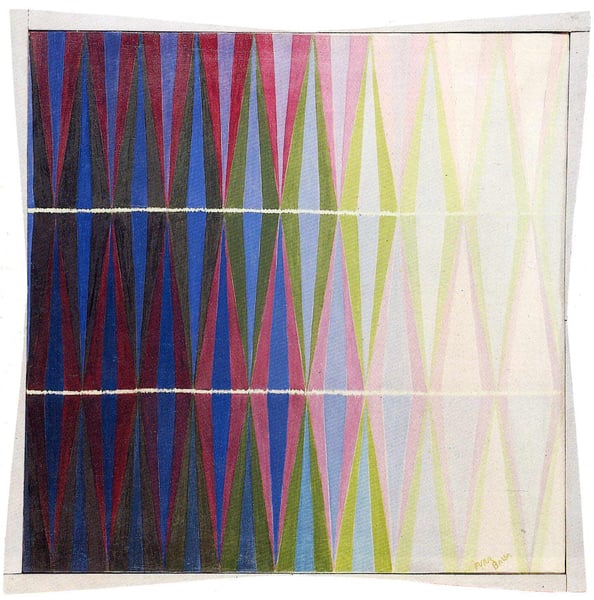
Giacomo Balla’s Iridescent Interpenetration No.7 stands as a pivotal work in the evolution of early 20th‑century abstraction. Although Balla is best known as a leading figure of Italian Futurism—celebrated for capturing speed and dynamic energy—this painting belongs to a remarkable series that marks his shift toward a more purely optical, non‑representational language.
The title itself is deeply instructive: “Iridescent” points to Balla’s fascination with the prismatic decomposition of light, while “Interpenetration” describes his systematic layering of translucent, overlapping planes. In No.7, Balla abandons recognizable subject matter entirely, focusing instead on the interplay of color, form, and spatial tension. The composition consists of interlocking geometric shapes—often triangles or wedge‑like bands—that seem to pulse and shift as they intersect. These forms are rendered in a high‑key, iridescent palette (pinks, blues, yellows, and greens) that suggests the refraction of sunlight through a glass prism or a vibrating membrane.
What Makes This Work Significant:
-
Bridge between Futurism and Pure Abstraction – While Balla’s earlier Futurist works (e.g., Dynamism of a Dog on a Leash) still retained recognizable motifs, the Iridescent Interpenetration series eliminates all figurative references. Here, movement is no longer depicted through blurred bodies or speeding cars but through the optical effect of color and shape interacting. This aligns Balla with simultaneous developments in Russian Suprematism (Malevich) and Dutch De Stijl (Mondrian), though his approach remains uniquely perceptual and fluid.
-
Emphasis on Perceptual Experience – The “interpenetration” of forms creates a sense of depth without using traditional linear perspective. Instead, Balla relies on the viewer’s eye to synthesize overlapping translucent shapes, generating an illusion of spatial oscillation. This anticipates later Op Art tendencies, yet retains a lyrical, almost musical quality.
-
Chromatic Innovation – The iridescent effect is achieved by juxtaposing complementary colors and modulating their intensity across the canvas. Balla likely drew on scientific color theories of the time (e.g., Michel‑Eugène Chevreul’s laws of simultaneous contrast) to create a surface that appears to glow from within. This interest in light as a subject in itself connects him to the contemporaneous Orphist movement (Robert Delaunay).
-
Monumentality within a Small Series – Because Balla produced only a limited number of Iridescent Interpenetration works, each one is a concentrated manifesto of his abstract ideals. No.7 exemplifies his mature style: a balanced, almost crystalline composition that feels both rigorous and spontaneous.
In summary, Iridescent Interpenetration No.7 is significant not only as a masterwork of Giacomo Balla’s abstract period but as a seminal document of how one Futurist used color, light, and geometric interpenetration to push painting beyond representation into a pure, self‑referential visual experience. It stands as a testament to the early 20th‑century drive to find universal, non‑objective forms that could express the rhythm and energy of modern life.
Museum / Gallery
Visually similar
20 works with related composition and palette
Iridescent Interpenetration No. 4 - Study of light
Giacomo Balla
Untitled
Max Bill
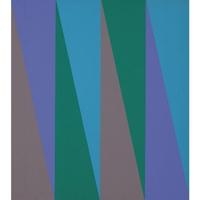
Structure triangulaire gris-brun
Guido Molinari
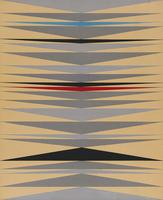
Tinta automotiva sobre madeira
Ivan Serpa
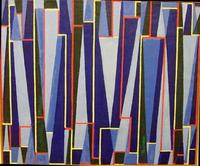
Untitled
Myron Stout
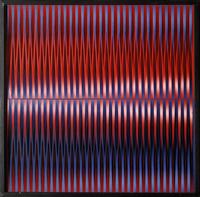
Mobile-Static M 0 27
Walter Leblanc
Stage II
Karl Benjamin
Iridescent Interpenetration No.5 - Eucalyptus
Giacomo Balla
Série Amazônica nº 2
Ivan Serpa
Viaje En Círculos Imaginarios
Sandu Darie
Faixas Ritmadas
Ivan Serpa
Breve
Jean Degottex
Echo
Leo Valledor
Composição
Ivan Serpa
Pair Impair
Manfred Kuttner
Cite
Ellsworth Kelly
to Vuillard (Red and Green)
Joyce Kozloff
Untitled
Harriet Korman
Determined Course
Kenneth Noland
Untitled
Karl Benjamin