
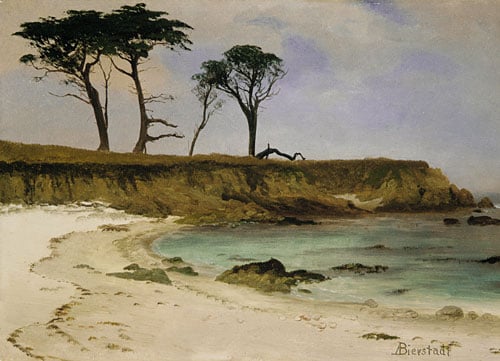
Analisi esperta di Sea Cove di Albert Bierstadt
Stile: Luminism · Genere: landscape
Expert Analysis of "Sea Cove" by Albert Bierstadt
Albert Bierstadt’s "Sea Cove" stands as a quintessential example of Luminism, a mid-19th-century American landscape style that prioritizes the subtle, transcendent effects of natural light. Though Bierstadt is more widely celebrated for his grand, dramatic panoramas of the American West, this work reflects a quieter, more intimate side of his practice—one that aligns closely with the Luminist emphasis on tranquility, atmospheric precision, and the spiritual resonance of nature.
Significance within Luminism:
The painting’s significance lies in its masterful rendering of luminous atmosphere. Luminist works are characterized by a soft, even glow that seems to emanate from within the scene itself, often achieved through meticulous layering of translucent glazes. In "Sea Cove," Bierstadt captures the reflective quality of still water, the hazy boundary between sea and sky, and the gentle diffusion of light across clouds and tide. This focus on ambient light—rather than dramatic weather or narrative action—places the work squarely within the Luminist tradition, where the primary subject is the visual and emotional experience of light itself.
Landscape as Sacred Space:
As a landscape painting, "Sea Cove" participates in the broader Hudson River School belief that the American wilderness was a site of divine presence. However, unlike Bierstadt’s vast, sublime mountain scenes, this cove is contained and serene, inviting quiet contemplation rather than awe. The composition likely employs a classic Luminist structure: a strong horizontal shoreline, a calm body of water in the middle ground, and a luminous sky above, all rendered with smooth brushwork and an almost photographic clarity. This stillness imbues the scene with a sense of timelessness—a hallmark of Luminism’s quest to elevate the mundane into the metaphysical.
Bierstadt’s Place in the Movement:
While Bierstadt is often classified under the broader Hudson River School, his specific treatment of "Sea Cove" demonstrates his engagement with Luminist ideals that were more commonly associated with contemporaries like Fitz Henry Lane and Martin Johnson Heade. The work is significant because it reveals Bierstadt’s versatility—his ability to shift from the epic scale of Yosemite to the unassuming beauty of a coastal inlet, all while maintaining the luminous clarity that defines the period. In capturing a fleeting moment of coastal calm, Bierstadt affirms that even the smallest cove can become a vessel for light’s transformative power, making "Sea Cove" a refined and serene contribution to American Luminist painting.
Museum / Gallery
Visivamente simili
20 opere con composizione e palette affini

California Coast
Albert Bierstadt
Monterey Cypress
Guy Rose
Carmel Beach
Guy Rose
Grey Afternoon
Guy Rose
The Bay of Cavalieri
Henri-Edmond Cross

Landscape
Hoca Ali Riza
Laguna Coast
Guy Rose
17 Mile Drive
Guy Rose
Mist Over Point Lobos
Guy Rose
Carmel Dunes
Guy Rose
La Jolla Cove
Guy Rose
Path along the Shore
Guy Rose

Scanian landscape with a view of Kullen
Louis Gurlitt
Carmel Seascape
Guy Rose
Coast Ledenets
Nicholas Roerich
A Grey Day Carmel
Guy Rose
View over the Sea from Ogna, Jæren
Kitty Lange Kielland
View of the Beach at Beverly, Massachusetts
John Frederick Kensett
Lifting Fog, Laguna
Guy Rose
View of the Beach at Beverly Massachusetts
John Frederick Kensett