Albert Bloch sanatçısının Prodigal eseri hakkında uzman analizi
Tarz: Symbolism · Tür: religious painting
Expert Analysis: "Prodigal" by Albert Bloch
Style: Symbolism
Genre: Religious painting
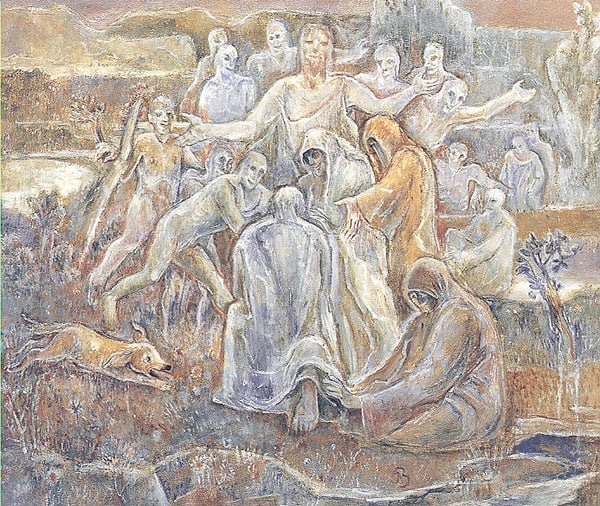
Albert Bloch’s "Prodigal" stands as a compelling intersection of Symbolist introspection and religious narrative, rendered through the lens of early 20th-century European modernism. While Bloch was an American painter, his active participation in the German Expressionist group Der Blaue Reiter (alongside Kandinsky and Marc) informs the work’s symbolic vocabulary and emotional intensity.
Significance within Symbolism and Religious Art:
- Psychological depth over literal narrative: Rather than depicting the Prodigal Son parable as a straightforward Biblical scene (return, feast, forgiveness), Bloch employs Symbolist ambiguity. The figure’s posture, isolation, and stark setting likely evoke the internal torment of alienation and repentance—a hallmark of Symbolism’s preoccupation with inner states and spiritual crisis.
- Color as spiritual transmitter: Bloch’s palette, influenced by both Fauvism and Der Blaue Reiter’s color theories, uses dissonant hues to convey emotional and metaphysical tension. The foreshortened, almost distorted figure aligns with Symbolism’s rejection of naturalism in favor of expressive form and symbolic meaning.
- Universalizing the sacred: “Prodigal” treats a Christian lesson (humility, redemption) through a lens that resonates with Symbolism’s broader interest in myth, morality, and the human condition. Bloch’s approach places it alongside works by James Ensor or Odilon Redon, where religious iconography becomes a vehicle for personal and modern philosophical inquiry.
Why It Matters:
- Bridging American and European avant-gardes: Bloch is one of the few American artists fully embraced by Der Blaue Reiter. “Prodigal” demonstrates how Symbolist religious painting could absorb Expressionist urgency while retaining a meditative, symbolic core—a rare synthesis that challenges the notion of Symbolism as purely European or purely literary.
- Precursor to later spiritual abstraction: Bloch’s bold, almost abstract handling of the prodigal figure foreshadows the move toward non-objective art that Kandinsky would champion, yet he anchors his symbolism in recognizable biblical typology. This balance makes “Prodigal” a key transitional work between representational symbolism and abstract spiritualism.
In "Prodigal," Bloch achieves a deeply personal yet archetypal vision of contrition and grace, securing his place as a singular voice within both Symbolist religious painting and the broader modernist canon.
Görsel olarak benzer
İlişkili kompozisyon ve renk paletine sahip 20 eser
The grieving women
Albert Bloch
Figures in silver light (study)
Albert Bloch
Pilgrims in the Snow
Albert Bloch
Figures on Dark Ground
Albert Bloch
Entombent
Albert Bloch
Suite
Margareta Sterian
Striking the Rock
Marc Chagall
The Reaper
Umberto Boccioni
Lamentation
Albert Bloch
Figures in silver light
Albert Bloch
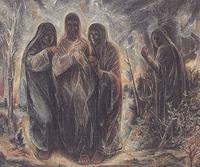
Walk to Emmaus
Albert Bloch
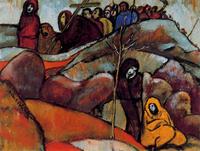
Procession with the Cross
Albert Bloch
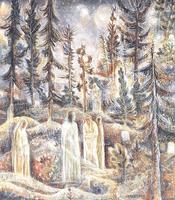
Vision in a Summer Night
Albert Bloch
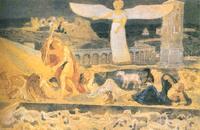
Adoration of the shepherds
Alexander Ivanov
Noah's Ark
Marc Chagall
A Sunshine Holiday
William Blake
The Dell
Gustave Dore
Saint Francis in the Woods
Albert Bloch
Jesús Manantial de Amor
José Garnelo
The Song of the Shepherd
Pierre Puvis de Chavannes