Analisi esperta di Dynamism of a Human Body di Umberto Boccioni
Stile: Futurism · Genere: abstract
Expert Analysis: "Dynamism of a Human Body" by Umberto Boccioni
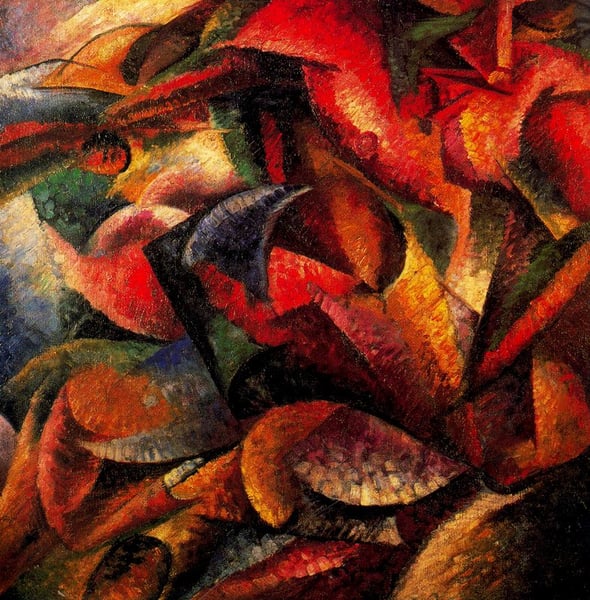
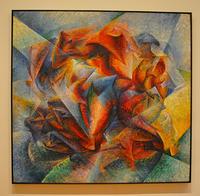
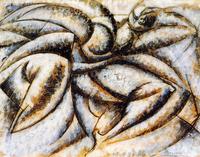
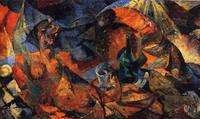
Umberto Boccioni’s “Dynamism of a Human Body” stands as a defining manifesto of the Futurist movement—a style that rejected static representation in favor of speed, energy, and the interpenetration of matter and motion. Though the work is abstract, it is not detached from reality; rather, it transcends literal depiction to capture the sensation of a body in action.
Significance within Futurism:
Boccioni, a leading theorist of Futurism, sought to break down the boundaries between object and environment, insisting that a moving body is not a fixed form but a fluid vortex of forces. In this piece, the human figure is dissolved into intersecting arcs, diagonal thrusts, and rhythmic lines that evoke centrifugal movement. The abstraction serves to eliminate a single viewpoint, instead presenting a “synthesis of what one remembers and what one sees”—a core Futurist ambition to render duration and motion simultaneously.
Why this artwork matters:
- It exemplifies the Futurist credo that “a racing automobile is more beautiful than the Victory of Samothrace.” Here, the human body is treated with the same dynamic intensity as a machine, its dynamism conveyed through force-lines that radiate energy outward.
- By choosing abstraction, Boccioni pushes beyond mere fragmentation (as seen in earlier Cubist works) to suggest psychological and physical momentum—the body is not broken but transformed into pure action.
- The painting directly realizes Boccioni’s own 1912 Technical Manifesto of Futurist Sculpture, where he called for art that expresses “the dynamic sensation itself” through interchangeable planes and interpenetrating masses.
In sum, “Dynamism of a Human Body” is a radical leap: it abandons the recognizable silhouette to give form to the invisible forces of motion, making it a cornerstone of Futurist abstraction and a precursor to later dynamic art movements.
Visivamente simili
20 opere con composizione e palette affini
Dynamism of a Human Body
Umberto Boccioni
Dynamism of a Cyclist
Umberto Boccioni
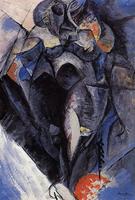
Figure
Umberto Boccioni
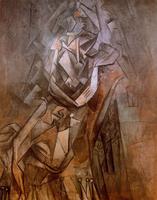
Woman sitting in an armchair
Pablo Picasso
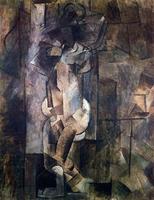
Nude figure
Pablo Picasso
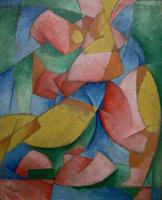
Figure
Morton Schamberg
Figure A (Geometrical Patterns)
Morton Schamberg
Composition I
Patrick Henry Bruce
Three women
Pablo Picasso
Quirinal Stables
Carlo Carra
Gul figur
Gosta Adrian-Nilsson
Small Composition III
Franz Marc
L'Acrobate
Jacques Villon
Tetragramista II
Oswaldo Vigas
Dynamism of a Soccer Player
Umberto Boccioni
Dynamism of the Human Body
Umberto Boccioni
Female Model
Lyubov Popova
Pink Angels
Willem de Kooning
Nude (complementary model of form-color)
Umberto Boccioni
Disjunction of forms
Olga Rozanova