Expertenanalyse zu Umberto Boccionis Signora Massimino
Stil: Divisionism, Impressionism · Genre: portrait
Expert Analysis of "Signora Massimino" by Umberto Boccioni
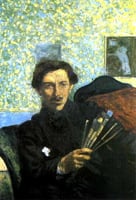
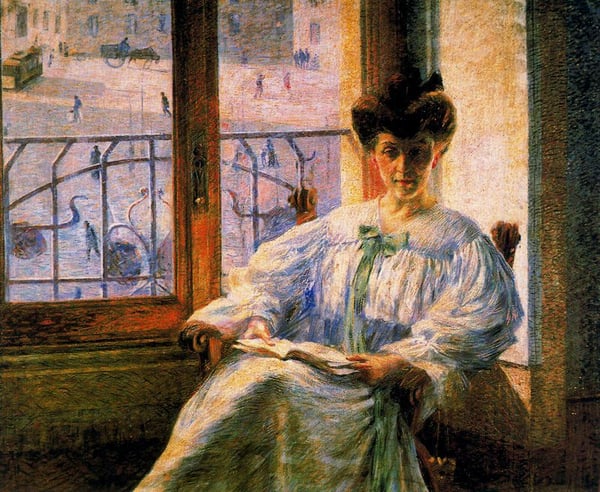
Umberto Boccioni’s Signora Massimino stands as a pivotal early work that bridges the artist’s formative engagement with Divisionism and Impressionism. Though Boccioni would later become a leading theorist and painter of Italian Futurism, this portrait reveals his deep technical grounding in the chromatic and textural innovations of late-19th-century movements.
The painting’s significance lies first in its Divisionist execution: Boccioni applies color in small, separate strokes or dots, a method derived from Georges Seurat and Italian Divisionists like Giovanni Segantini. This technique allows light to be optically blended by the viewer’s eye, generating a luminous, vibrating surface. Even within a portrait—a traditionally static genre—the Divisionist brushwork injects a sense of atmospheric energy and fleeting impression, aligning with the Impressionist emphasis on capturing a momentary sensation.
Secondly, the work demonstrates Boccioni’s mastery of psychological nuance through color and broken brushwork. The sitter, Signora Massimino, is rendered not with seamless modeling but through a network of contrasting hues that articulate both form and mood. The interplay of warm flesh tones with cool, complementary shadows (likely blues and violets) suggests an interior life, while the looser handling in the background recalls Impressionist portraits by Degas or Renoir.
Crucially, Signora Massimino is significant as a document of Boccioni’s evolution. Between 1907 and 1909, he absorbed Divisionism and Impressionism in Milan and Paris, synthesizing their lessons prior to adopting the dynamic, machine-age vocabulary of Futurism. The portrait’s static composition—traditional bust or half-length—belies the explosive energy Boccioni would later unleash in works like The City Rises. Thus, it represents a foundational stage: a disciplined exercise in optical color theory and momentary perception that provided the formal bedrock for his revolutionary break with the past. In this sense, the painting is not merely a portrait but a threshold work, illustrating how even a seemingly conventional genre could become a laboratory for modernist experimentation.
Visuell ähnlich
20 Werke mit ähnlicher Komposition und Farbpalette
The Artist's Sister at a Window
Berthe Morisot
The Reader
Mary Cassatt
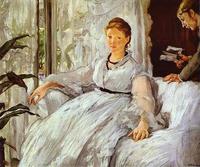
The reading
Edouard Manet
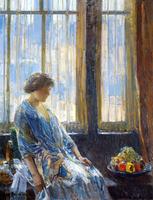
The New York Window
Childe Hassam
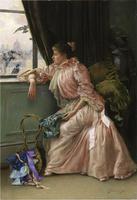
Room with a View
Julius LeBlanc Stewart
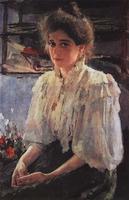
Portrait of Maria Lvova
Valentin Serov
At the coffee house
Alessandro Milesi
The Breakfast Room, Winter Morning
Childe Hassam
Portrait of a lady, yellow gown, purple scarf
Rodolfo Amoedo
Portrait of a young woman in white
Pierre-Auguste Renoir
At the Window
William Merritt Chase
Young Girl With Her Handwork
Wenzel Tornøe
Portrait of Sofia Golitsyna
Konstantin Korovin
Portrait of a seated lady
Constant Mayer
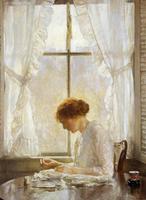
The Seamstress
Joseph DeCamp
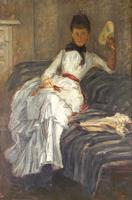
A Visitor
Sarah Purser
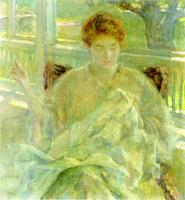
Spring
Robert Lewis Reid
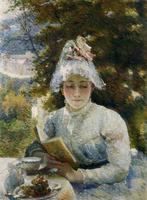
Le Gouter
Marie Bracquemond
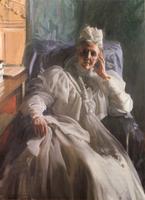
Queen Sophia
Anders Zorn
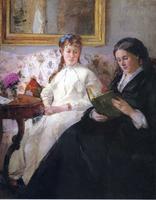
Portrait of the Artist's Mother and Sister
Berthe Morisot