
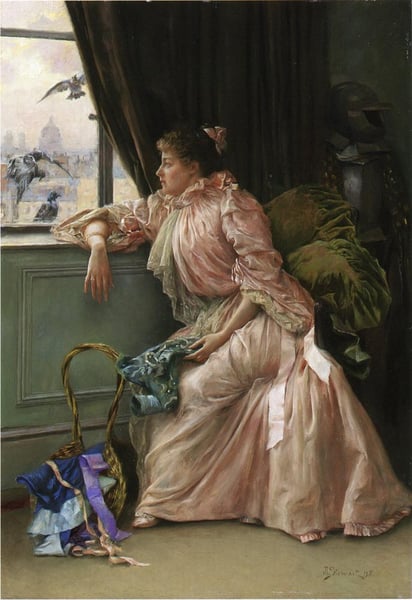
Expert analysis of Julius LeBlanc Stewart’s Room with a View
Style: Realism · Genre: genre painting
Expert Analysis: Room with a View by Julius LeBlanc Stewart
Julius LeBlanc Stewart (1855–1919) was an American expatriate painter who spent most of his career in Paris, where he became closely associated with the refined world of the haute bourgeoisie and the international social elite. Stylistically, Stewart worked within the Realist tradition, though his later works often absorbed the lighter palette and looser brushwork of Impressionism without abandoning the descriptive precision of Realism.
Room with a View — while the specific composition is not described in the supplied data — can be understood as a genre painting (a scene of everyday life) executed in a Realist mode. In the context of Stewart’s oeuvre, such works typically depict elegant interiors, fashionable figures, and moments of quiet leisure, often with a carefully observed interplay of interior space and exterior landscape. The title itself suggests a deliberate juxtaposition: an intimate, enclosed domestic space set against an open vista, perhaps a window or balcony looking out onto a garden, a cityscape, or the sea.
Significance within Realism and Genre Painting:
-
Realism’s commitment to contemporary life: Stewart’s work exemplifies the Realist goal of depicting the modern world truthfully, without idealization. Unlike the historical or mythological subjects favored by academic painting, Room with a View focuses on the immediate, tangible environment of the artist’s own time — the sunlit room, the decorative objects, the posture of a figure lost in thought or conversation. This aligns with the Realist credo of Gustave Courbet and later practitioners who sought to “paint the age in which one lives.”
-
Transatlantic perspective: Stewart was part of a circle of American artists in Paris (alongside John Singer Sargent and James McNeill Whistler) who blended European Realist techniques with American subject matter or sensibilities. In Room with a View, the significance lies in how Stewart captures the intersection of private space and public spectacle — a theme that resonated with Gilded Age audiences who valued both domestic refinement and social display. The “view” may signify the character’s (or viewer’s) place within a larger world, making the work a subtle commentary on class, leisure, and the performance of modernity.
-
Genre painting elevated: Stewart took what could have been a simple anecdotal scene and infused it with atmospheric depth and psychological presence. His handling of light — filtering through a window, falling across fabrics and flesh — demonstrates a mastery of Realist observation that rivals his French contemporaries. The painting’s significance also lies in its embodiment of the intimiste trend within later Realism: a focus on quiet, inward moments rather than dramatic action, prefiguring the interior scenes of the Nabis and other early modernists.
In sum, Room with a View is significant for its synthesis of Realist fidelity, genre tradition, and an American expatriate’s distinct perspective on European high life. It stands as a refined example of how Realism, by the late 19th century, had evolved from Courbet’s earthbound ambitions into a vehicle for exploring psychological nuance and the subtleties of light and space — all while remaining firmly anchored in the observable world.
Museum / Gallery
Visually similar
20 works with related composition and palette
In The Studio
William Merritt Chase
Stefanie Fürth
Julius Schmid
Spring
James Tissot
The Reluctant Mistress
Raimundo de Madrazo
Portrait of a seated lady
Constant Mayer
Portrait of a Lady with a Red Scarf
Paul Émile Chabas
Young woman in pink with her child
Pascal Dagnan-Bouveret
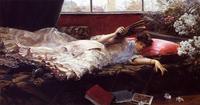
An Idle Afternoon
Julius LeBlanc Stewart
Woman with a Picnic Basket
Raimundo de Madrazo
The toilet
Raimundo de Madrazo
Reverie
Alfred Stevens
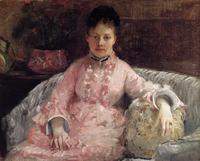
Portrait of a Woman in a pink dress
Berthe Morisot
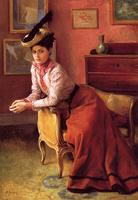
Woman in an Interior
Julius LeBlanc Stewart
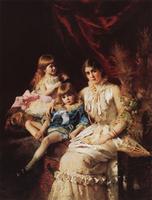
Portrait
Konstantin Makovsky
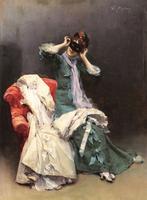
Preparing for the Costume Ball
Raimundo de Madrazo
A Family Group, The Artist's Wife and Children, 'Papa Painting!'
Solomon Joseph Solomon
An Afternoon Idyll
Auguste Toulmouche
Woman Drinking A Hot Chocolate
Raimundo de Madrazo
The comforting words
Gustave Léonard De Jonghe The Japanese Fan

Portrait Of Mrs Charles Wyllie
Sir Lawrence Alma-Tadema