Expertenanalyse zu Umberto Boccionis Twilight
Stil: Divisionism · Genre: cityscape
Expert Art Historical Analysis: "Twilight" by Umberto Boccioni
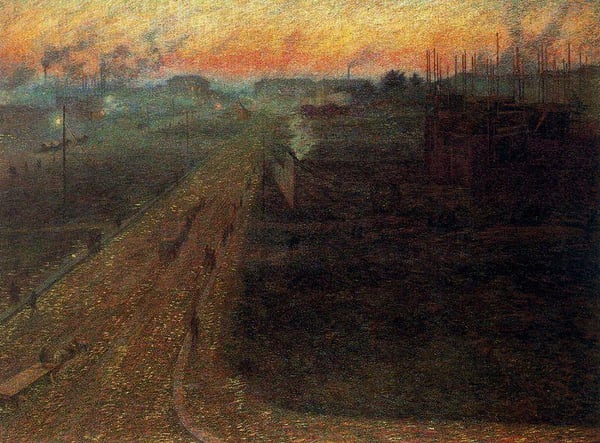
"Twilight" by Umberto Boccioni is a compelling cityscape executed in the Divisionist style, a technique that defines the painting’s visual texture and its place within the artist’s early development. Created before Boccioni fully embraced the radical dynamism of Futurism, this work captures a transitional moment—both in the time of day and in the artist's own stylistic evolution.
Significance within Divisionism:
Divisionism, derived from Neo-Impressionist color theory, involves the systematic application of small, distinct dots or strokes of pure color, intended to blend optically in the viewer’s eye rather than on the palette. In Twilight, Boccioni uses this method to render the subtle, dissolving light of dusk over an urban landscape. The broken, shimmering brushwork transforms the cityscape into a vibrating field of luminosity, emphasizing atmosphere over solid form. This approach highlights Boccioni’s early interest in the interplay of natural and artificial light—a theme that would later become central to the Futurist obsession with modern urban energy.
Precursor to Futurist Concerns:
While the painting remains static in composition, its Divisionist handling infuses the scene with a sense of flickering motion and temporal flux. The soft, almost hazy outlines of buildings and streets suggest that the city is not a fixed monument but a living entity, constantly reshaped by light and mood. This prefigures the Futurist fascination with speed, simultaneity, and the charged atmosphere of modern life. Boccioni’s focus on twilight—a liminal moment between day and night—parallels the Futurist celebration of transition, change, and the breaking down of old boundaries.
Emotional and Urban Resonance:
The palette of muted purples, oranges, and blues creates a melancholic yet vibrant atmosphere, evoking the quiet afterglow of industrial activity. The city is depicted not as a bustling, noisy machine but as a near-abstract pattern of light and color, where human presence is implied rather than directly shown. This ambiguity invites the viewer to experience the subjective, emotional impact of the urban environment—a hallmark of Boccioni’s later explorations of psychological sensation in works like The City Rises.
Conclusion:
Twilight is significant as a masterful example of Divisionist technique and as a crucial stepping-stone toward Boccioni’s Futurist manifesto. It demonstrates that even before his full embrace of motion and machinery, Boccioni was already deconstructing visual reality through light and color, seeking to capture the fleeting, transformative essence of the modern city. This work stands as a vital bridge between the contemplative stillness of late-19th-century painting and the explosive energy of 20th-century avant-garde art.
Museum / Gallery
Visuell ähnlich
20 Werke mit ähnlicher Komposition und Farbpalette
Nocturne in Blue and Gold – Valparaiso Bay
James McNeill Whistler
River Landscape by Moonlight
George Henry
Ciudad en brumas
Roberto Montenegro
Saint Ouen, le Marché Malik, l'hiver
Pierre-Jacques Pelletier
The Morning
Umberto Boccioni
Ile Lacruix, Rouen. Effect of Fog.
Camille Pissarro
Arden's Farm, Swinton
L. S. Lowry
Nocturn Sun
James McNeill Whistler
A Firework Display at the Crystal Palace
Frederick George Cotman
The Thames Above Waterloo Bridge
J.M.W. Turner
Nocturne in Blue and Gold Valparaiso Bay
James McNeill Whistler
Charing Cross Bridge, Fog on the Themes
Claude Monet
Christ and His Desciples on the Road to Bethany
Henry Ossawa Tanner
Twilight
Clarence Gagnon
Sunset at the Outskirts of Town
Konstantin Korovin
Rondout, New York
Leon Dabo
The Burning of the Houses of Parliament
J.M.W. Turner
Boats on the Thames, London
Claude Monet
Christmas Eve
George Inness
In the Outskirt of the City
Laszlo Mednyanszky