Analisi esperta di The Morning di Umberto Boccioni
Stile: Divisionism · Genere: landscape
Expert Analysis of "The Morning" by Umberto Boccioni
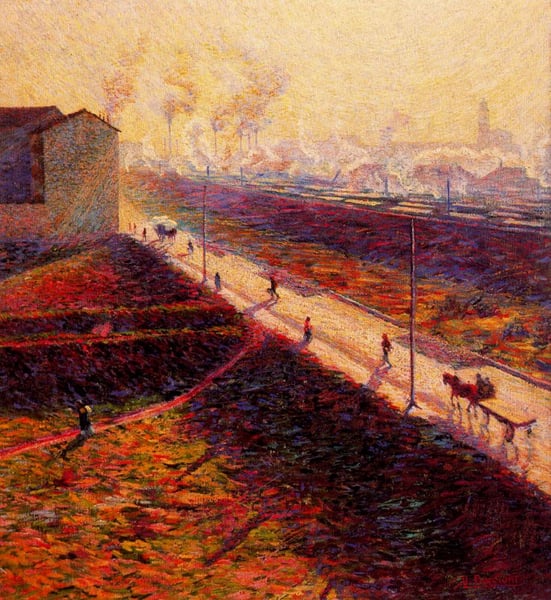
Umberto Boccioni’s “The Morning” stands as a pivotal early work within the artist’s career and the broader trajectory of Italian modernism. Executed in a Divisionist style and classified as a landscape, this painting exemplifies a crucial transitional moment—one in which Boccioni, soon to become a leading figure of Futurism, rigorously applies the scientific color theories of Divisionism to capture the ephemeral, dynamic qualities of light and atmosphere.
Art-Historical Significance within Divisionism
-
Divisionist Technique as a Foundation for Futurism: Divisionism, derived from Neo-Impressionism, involves the optical mixing of pure, separate strokes of color. In “The Morning,” Boccioni employs this method not merely as a decorative device but as a tool to convey the vibrant, pulsating energy of nature at dawn. The landscape is broken into dabs and filaments of complementary hues—cool blues and violets contrasted with warm yellows and pinks—that, when viewed from a distance, blend in the viewer’s eye to create a luminous, shimmering effect. This technique anticipates the Futurist obsession with speed, light, and the dissolution of static forms.
-
Subject as a Vehicle for Modern Sensibility: While the genre is a traditional rural landscape, Boccioni’s treatment is radically modern. He does not present a passive, pastoral idyll; instead, the painting captures morning as an event—a sensory explosion of light bursting through mist, the shimmer of dew, the vibrancy of the sky’s transition from night to day. The Divisionist strokes themselves mimic the flickering, fragmented perception of reality that would later define Futurist painting. The work thus bridges the calm observation of Impressionist-derived Divisionism and the aggressive, forward-rushing aesthetic of Futurism.
-
Precursor to Boccioni’s Mature Style: Painted before his famous Manifesto of Futurist Painting (1910), “The Morning” demonstrates that Boccioni was already experimenting with the breaking of form and the rendering of dynamic sensation through color and touch. The landscape is not a static vista but a field of vibrating color patches, each stroke contributing to a sense of atmospheric motion. This emphasis on the kinetic, perceptual experience of nature directly fed into his later works like “The City Rises” and “Unique Forms of Continuity in Space.”
Conclusion
“The Morning” is a masterful example of Divisionist landscape painting that reveals Boccioni’s early mastery of optical color theory while foreshadowing the kinetic, modernist breakthroughs of Futurism. Its significance lies in its dual role: as a technical tour de force within the Divisionist movement, and as a crucial step toward the dissolution of static representation in favor of a dynamic, immersive vision of reality.
Visivamente simili
20 opere con composizione e palette affini
Factories At Porta Romana
Umberto Boccioni
Twilight
Umberto Boccioni
Pejzaż Podmiejski Z Okolic Paryża
Stanisław Wyspiański
The Western Railway at its Exit from Paris
Charles Angrand
The Train, Bedford Park
Camille Pissarro
Scehiber Hugó, Tűz 1922
Scheiber Hugó
Landscape in Autumn
Gustave Loiseau
Landscape with Figure
Joaquín Sorolla
Train in the Snow at Argenteuil
Claude Monet
April Evening
Umberto Boccioni
Trouville, the Ferry to Deauville
Eugene Boudin
Fecamp, the Inner Port under Construction
Eugene Boudin
Winter landscape
Giuseppe De Nittis
Site With Train Tracks and Houses
Walter Gramatté
Suburb
Georges Seurat
Sunset at Ivry
Armand Guillaumin
View of Argenteuil in the Snow
Claude Monet
Dieppe, Dunquesne Basin, Low Tide, Sun, Morning
Camille Pissarro
Spring Landscape with train
Pyotr Konchalovsky
Port de Javel
Paul Gauguin