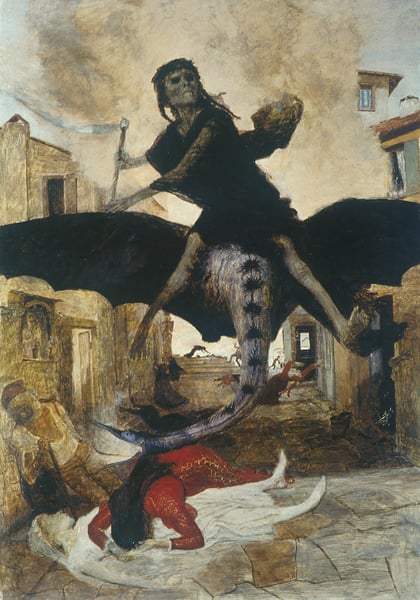
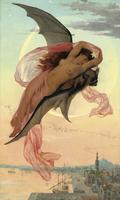
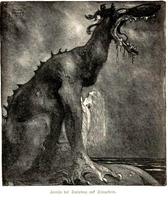
As a Symbolist allegorical painting, Arnold Böcklin's The Plague gains its significance through the fusion of its style and genre. The Symbolist movement prioritized subjective emotion and the evocation of ideas over literal representation, while allegorical painting uses personified figures and symbolic imagery to convey a moral or philosophical message. In this work, Böcklin likely renders the plague not as a mere historical event but as a timeless, haunting embodiment of human dread and mortality. The painting’s significance lies in its ability to transform a specific catastrophe into a universal, symbolic meditation on fear—achieved through the characteristic Symbolist emphasis on mood, ambiguity, and the power of mythic or archetypal imagery. The allegorical approach allows the plague to function as a dark mirror of the psyche, making the work a key example of how Symbolist artists used traditional allegorical forms to explore modern existential anxieties.