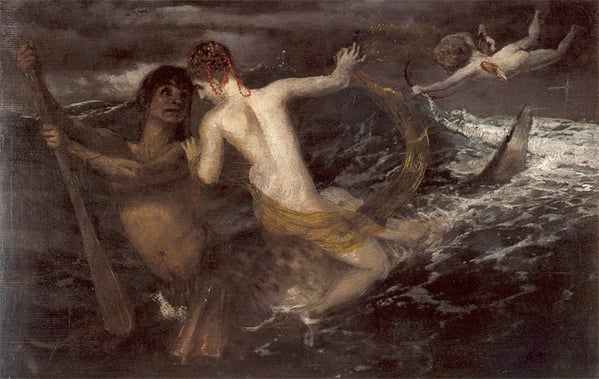
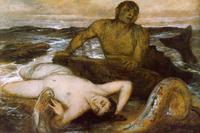
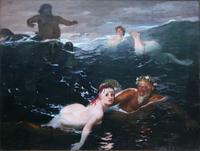
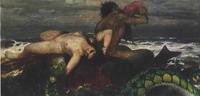
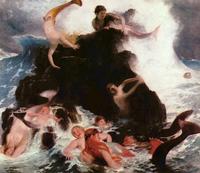
Arnold Böcklin’s Triton carrying a nereid on his back is a quintessential Symbolist mythological painting. The work’s significance lies in how it synthesizes its style and genre: Symbolism’s emphasis on evocative, subjective meaning merges with the classical myth of Triton and a nereid to create a scene that is less a narrative illustration and more a dreamlike embodiment of elemental forces. The juxtaposition of the sea‑god’s raw, animalistic power (Triton) with the nereid’s ethereal, passive grace captures Symbolism’s fascination with dualities—nature versus spirit, wildness versus beauty. By stripping the myth of overt storytelling and focusing on the charged, ambiguous relationship between the two figures, Böcklin elevates the painting from a simple mythological episode to a resonant symbol of desire, dominance, and the mysterious union of sea and human‑like forms. This approach made the work a touchstone for Symbolist artists seeking to transform classical subjects into vehicles for psychological and emotional exploration.