Expert analysis of Nikolay Bogdanov-Belsky’s Portrait of a Woman
Style: Impressionism · Genre: portrait
Expert Analysis of Portrait of a Woman by Nikolay Bogdanov-Belsky
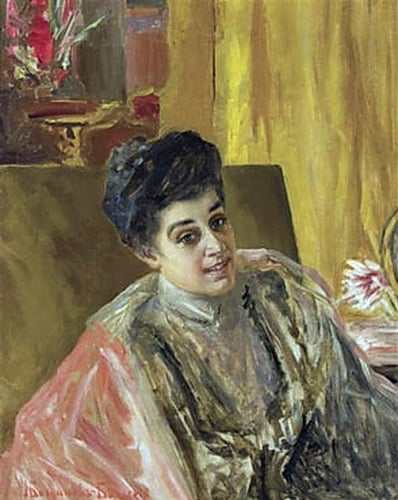
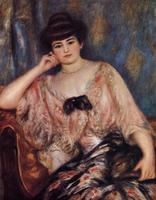
Nikolay Bogdanov-Belsky’s Portrait of a Woman occupies a distinctive position at the intersection of Russian portraiture and French Impressionism. While Bogdanov-Belsky is often celebrated for his genre scenes of village schoolchildren and rural life, this portrait demonstrates his mastery of the Impressionist idiom applied to the intimate, psychological study of a sitter.
Significance within Impressionism:
The work embodies the core Impressionist concern with capturing the transient effects of light and atmosphere. Bogdanov-Belsky employs a broken brushstroke and a nuanced, high-key palette—likely favoring soft blues, roses, and warm flesh tones—to model the woman’s face and costume. The focus is not on meticulous, academic detail but on the overall sensation of the moment: the play of light across her features, the airiness of the background, and the sense of a fleeting, candid expression. This aligns with Impressionism’s rebellion against the polished finish of official portraiture.
Significance as a Portrait:
Unlike the formal, posed portraits of the Russian Academy, this painting suggests psychological intimacy. The woman’s gaze and relaxed posture indicate a private, unguarded moment. Bogdanov-Belsky brings the Impressionist priority of “truth to the optical experience” into the service of character revelation: the viewer sees not just a likeness, but a living presence shaped by light and mood. The work thus bridges the emotional realism of the Russian Peredvizhniki (Wanderers) tradition—with which the artist was initially associated—and the French Impressionist emphasis on spontaneity and perception.
What Makes This Work Significant:
In the broader context of Russian art, Portrait of a Woman exemplifies how Impressionist techniques were adapted to suit a more introspective, national sensibility. Rather than the leisurely scenes of Parisian life that typified French Impressionism, Bogdanov-Belsky channels the same visual language into a quiet, personal portrait. This synthesis makes the painting a compelling example of cross-cultural artistic exchange, demonstrating that Impressionism was not merely a French phenomenon but a flexible, global vocabulary for expressing modern subjectivity. The work is significant as a testament to Bogdanov-Belsky’s versatility—proving that his art extended beyond narrative genre scenes to masterful, light-infused portraiture that captures both the outer appearance and the inner life of its subject.
Visually similar
20 works with related composition and palette
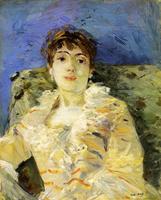
Young Woman on a Couch
Berthe Morisot
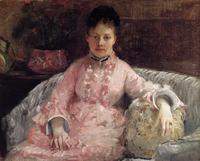
Portrait of a Woman in a pink dress
Berthe Morisot
Misia with a Pink Corsage
Pierre Bonnard
Portrait of a Woman
Pierre-Auguste Renoir
The Blond (Portrait of Tevashova)
Ilya Repin
Sybil Frances Grey, later Lady Eden
John Singer Sargent
Woman in White (Zofia Federowiczowa)
Olga Boznańska
Young Woman
Berthe Morisot
Miss Eden
John Singer Sargent
Antoinette at her dresser
Mary Cassatt
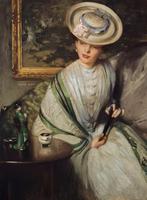
East and West
George Henry

In The Studio
William Merritt Chase
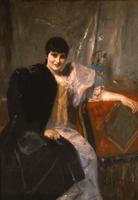
Portrait of Artemis Gyzi
Nikolaos Gyzis
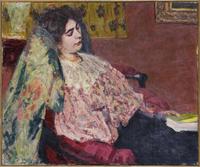
Rest
Roderic O'Conor
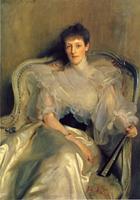
Mrs. Ian Hamilton (Jean Muir)
John Singer Sargent
Mrs. Kate A More
John Singer Sargent
Woman at Her Toilette
Mary Cassatt
Charlotte Blanche Shaw (1864–1897)
Herbert Arnould Olivier
Lisen Lamm
Anders Zorn
Misia
Pierre-Auguste Renoir