
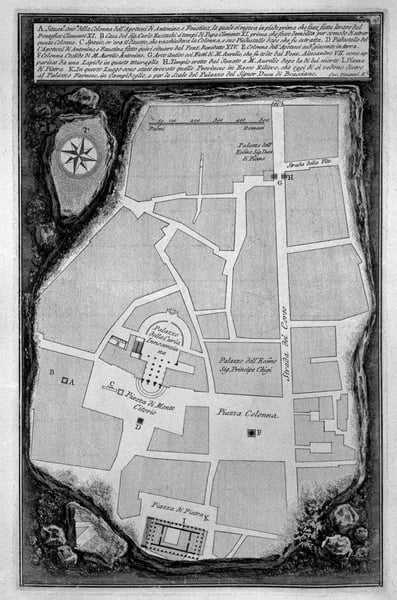
Have set up modern pedestal stand by Benedict XIV
Analyse experte de Have set up modern pedestal stand by Benedict XIV de Giovanni Battista Piranesi
Style : Neoclassicism · Genre : design
This work by Giovanni Battista Piranesi, "Have set up modern pedestal stand by Benedict XIV," is a significant example of Neoclassical design, reflecting the artist's dual role as both an imaginative etcher and a learned architect. While Piranesi is best known for his evocative Vedute (views) of Rome and his capricious Carceri (prisons), this piece belongs to his output as a designer of functional and ornamental objects.
Significance within Neoclassicism:
The artwork exemplifies the Neoclassical reverence for antiquity filtered through a distinctly Piranesian lens. The title directly references Pope Benedict XIV (reigned 1740–1758), a pontiff who actively championed archaeological exploration and the revival of classical forms. By dedicating this modern pedestal stand to him, Piranesi aligns his design with the papal endorsement of ancient Roman grandeur as a model for contemporary taste.
However, Piranesi’s Neoclassicism is never merely academic. Unlike the cool, rational purity of his contemporaries (such as Winckelmann’s or Canova’s ideals), Piranesi injected his designs with dramatic scale, complex ornament, and a sense of imposing monumentality. Here, the phrase "modern pedestal stand" suggests a functional object—likely for a sculpture or a commemorative bust—but executed with the gravity of a classical triumphal column. The stand is not a simple support but a self-contained architectural statement.
Piranesi as Designer:
This work is notable because it positions Piranesi within the applied arts, a less-heralded aspect of his career. Most surviving designs from his hands are etchings, but here we see his direct engagement with three-dimensional form. The pedestal likely incorporates motifs such as heavy moldings, acanthus leaves, lions’ paws, or incised Latin inscriptions—hallmarks of his architectural vocabulary. The piece’s significance lies in its synthesis of archaeological precision (derived from his studies of Roman ruins) and a bold, theatrical presence that anticipates later Neoclassical furniture and decorative arts.
In essence, "Have set up modern pedestal stand by Benedict XIV" demonstrates how Piranesi translated ancient stone into a modern civic statement: a pedestal that elevates not only its intended object but also the prestige of the patron and the enduring authority of classical Rome.
Visuellement similaire
20 œuvres à la composition et à la palette proches

A plan of Imola
Leonardo da Vinci
Map of The Hague
Joan Blaeu

Map of Peter Pan's Kensington Gardens
Arthur Rackham
Map of Rome and the Campus Martius with the relevant Index and dedication to Clement XIII in three sheets, and title listed
Giovanni Battista Piranesi
Topography of the factories discovered in the city of Pompeii, with a dedication to St. M King Gustavus Adolphus of Sweden
Giovanni Battista Piranesi
The Roman antiquities, t. 3, Plate XLIV. Pyramid of Caius Cestius map at the Port of St. Paolo.
Giovanni Battista Piranesi
Moscow
Joan Blaeu

The Roman antiquities, t. 1, Plate III. Map of ancient Rome and Forma Urbis.
Giovanni Battista Piranesi
Plan of the existing factories in the Villa Adriana, with a dedication to St. M Stanislaus Augustus, King of Poland
Giovanni Battista Piranesi
The Roman antiquities, t. 1, Plate XLII. Plan of the Baths of Diocletian
Giovanni Battista Piranesi
The Roman antiquities, t. 1, Plate XXXVIII
Giovanni Battista Piranesi
The Roman antiquities, t. 1, Plate XXXIX
Giovanni Battista Piranesi
The Roman antiquities, t. 2, Plate VIII. Entry of the burial chamber of L. Liberti and Family Arrunzio.
Giovanni Battista Piranesi
The Roman antiquities, t. 1, Plate II. Map of ancient Rome and Forma Urbis.
Giovanni Battista Piranesi

Plan of the existing factories in the Villa Adriana, with a dedication to St. M Stanislaus Augustus, King of Poland
Giovanni Battista Piranesi
Boys’ Art #2: Nagasaki
Joyce Kozloff

Plan of the existing factories in the Villa Adriana, with a dedication to St. M Stanislaus Augustus, King of Poland
Giovanni Battista Piranesi
Plan of the existing factories in the Villa Adriana, with a dedication to St. M Stanislaus Augustus, King of Poland
Giovanni Battista Piranesi

Map
John Hinton
The destruction of Pompeii
Giovanni Battista Piranesi