
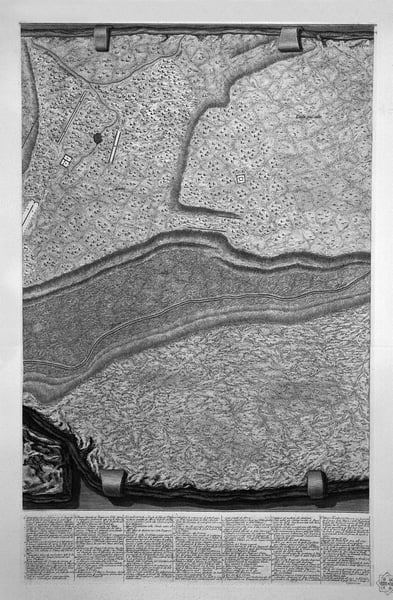
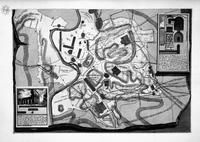
Plan of the existing factories in the Villa Adriana, with a dedication to St. M Stanislaus Augustus, King of Poland
Analisi esperta di Plan of the existing factories in the Villa Adriana, with a dedication to St. M Stanislaus Augustus, King of Poland di Giovanni Battista Piranesi
Stile: Neoclassicism · Genere: cityscape
This work, a meticulously rendered architectural plan by Giovanni Battista Piranesi, stands as a pivotal document within the Neoclassical movement, bridging archaeological precision with artistic grandeur. Its significance lies in Piranesi’s dual role as both a visionary artist and a scholar of antiquity.
Scholarly Precision Meets Artistic Drama
Rather than a mere technical blueprint, Piranesi elevates the “plan” into a compositional cityscape. He etches the sprawling remains of Hadrian’s Villa—a vast imperial retreat—with archaeological fidelity, mapping its ruined “factories” (an 18th-century term for building complexes). Yet his trademark use of deep chiaroscuro and dramatic foreshortening transforms dry survey data into a theatrical panorama, emphasizing the sublime scale of Roman engineering. This approach prefigures the Romantic obsession with ruin and decay, while remaining firmly grounded in Neoclassicism’s reverence for classical order.
A Patronage of Enlightenment Ambition
The dedication to Stanislaus Augustus, the reform-minded King of Poland, underscores the work’s political and intellectual context. Stanislaus, a passionate collector and patron of the arts, sought to revive Polish culture through classical ideals. By dedicating this print to him, Piranesi aligns his own archaeological enterprise with Enlightenment ideals of knowledge, power, and national renewal. The plan thus functions as a diplomatic gift and a scholarly tool, cementing Piranesi’s reputation as the preeminent interpreter of Rome for Europe’s elite.
Influence on Neoclassical Architecture and Design
Piranesi’s plans of ancient complexes like the Villa Adriana directly inspired Neoclassical architects—from Robert Adam in Britain to Étienne-Louis Boullée in France—who studied his plates to understand Roman spatial organization and ornament. The work’s detailed rendering of axial layouts, thermæ, and pavilions provided a lexicon of classical forms that architects reimagined for modern civic buildings. In this way, the print is not merely retrospective; it actively shapes the built environment of the 18th and 19th centuries.
A Synthesis of Genre and Style
Categorized as a cityscape, the plan transcends its genre by immersing the viewer in a vanished landscape. Piranesi’s etching technique—with its short, energetic lines and velvety blacks—conveys both the texture of eroded stone and the ghostly presence of what once stood. This synthesis of ruin, map, and vision makes the work a cornerstone of Neoclassical print culture, demonstrating how art could serve archaeology, pedagogy, and aesthetic wonder simultaneously.
In essence, this print encapsulates Piranesi’s genius: it is a scientific record, a baroque stage set, and a manifesto for the enduring power of classical antiquity.
Visivamente simili
20 opere con composizione e palette affini

Plan of the existing factories in the Villa Adriana, with a dedication to St. M Stanislaus Augustus, King of Poland
Giovanni Battista Piranesi
Plan of the existing factories in the Villa Adriana, with a dedication to St. M Stanislaus Augustus, King of Poland
Giovanni Battista Piranesi

Cosmic Map
Bruno Munari

Bodies of Water- Cities of China
Joyce Kozloff

Map
John Hinton

Comitatus Hanau ... Solms, Budingen et Nidda cum reliqua Wetteravia
Johann Christoph Homann

Accuratissima Sliae Fluminis Descriptio ... Iohannes Mejer
Joan Blaeu

Map of Rome and the Campus Martius with the relevant Index and dedication to Clement XIII in three sheets, and title listed
Giovanni Battista Piranesi
The Roman antiquities, t. 1, Plate II. Map of ancient Rome and Forma Urbis.
Giovanni Battista Piranesi

Mushroom Book Plate X
John Cage
Bodies of Water: Songlines
Joyce Kozloff

Plan of the existing factories in the Villa Adriana, with a dedication to St. M Stanislaus Augustus, King of Poland
Giovanni Battista Piranesi

Carte
Andre-Pierre Arnal

Map of Swabia and Wirtenberg, Germany
Matthaeus Seutter

Topography of the factories discovered in the city of Pompeii, with a dedication to St. M King Gustavus Adolphus of Sweden
Giovanni Battista Piranesi

Carte
Andre-Pierre Arnal

Have set up modern pedestal stand by Benedict XIV
Giovanni Battista Piranesi
The Roman antiquities, t. 1, Plate XXXVIII
Giovanni Battista Piranesi

A plan of Imola
Leonardo da Vinci

Map of Rome and the Campus Martius with the relevant Index and dedication to Clement XIII in three sheets, and title listed
Giovanni Battista Piranesi