Expertenanalyse zu Giovanni Battista Piranesis The Giant Wheel
Stil: Neoclassicism · Genre: capriccio
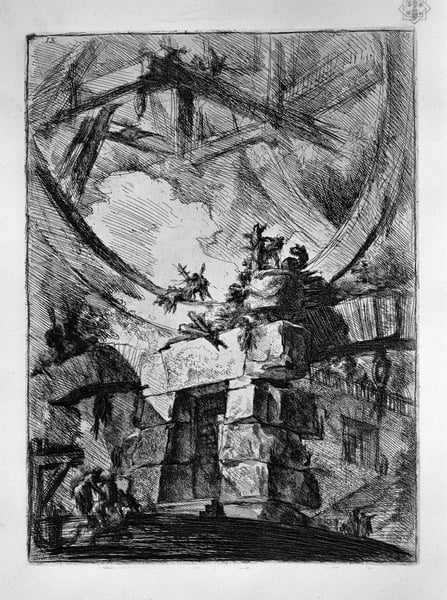
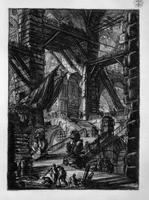
In Giovanni Battista Piranesi’s etching The Giant Wheel (part of his Carceri d’Invenzione or Imaginary Prisons series), the artist fuses the structured grandeur of Neoclassicism with the fantastical license of the capriccio genre, creating a work that is both a precise archaeological fantasy and a profound meditation on scale, ruin, and human ambition.
Formal and Compositional Analysis
The composition is dominated by an enormous, architecturally impossible wheel—part machine, part colossal sculpture—that fills the foreground and looms over a cavernous, vaulted interior. Piranesi uses aggressive, overlapping lines and deep chiaroscuro to create a sense of vertiginous depth. The wheel itself is rendered with obsessive detail: spokes, gears, and broken masonry intermingle, suggesting both a functional mechanism and a ruin. Tiny human figures—almost lost in the shadows—climb ladders or stand on catwalks, emphasizing the overwhelming scale. The perspective is intentionally distorted, pulling the viewer’s eye upward into a series of arches, chains, and stairways that lead nowhere, defying rational space.
Significance within Neoclassicism and the Capriccio
Piranesi’s work is significant because it pushes Neoclassical architectural idealism into a darkly imaginative realm. While contemporary Neoclassical painters often depicted orderly, heroic scenes from antiquity, Piranesi’s capriccio revels in the sublime terror of decayed, overwhelming structures. The Giant Wheel exemplifies his ability to blend rigorous etching technique—derived from his training as an architect and printmaker—with a deeply personal, almost obsessive vision of ancient Roman engineering run amok. The wheel itself can be seen as a symbol of both human ingenuity and futility, a machine that never turns, trapped in a timeless, labyrinthine prison.
Historical and Artistic Legacy
This etching, along with the rest of the Imaginary Prisons, influenced generations of Romantic and Surrealist artists—from Victor Hugo’s drawings to M.C. Escher’s impossible architectures. Piranesi’s genius lies in making the implausible feel archeologically authentic: the massive wheel, though a figment of fantasy, is built from authentic Roman motifs—keystone arches, rusticated stone, iron tie-rods—transforming an invention into a plausible relic. The Giant Wheel remains a landmark of the capriccio genre because it demonstrates how Neoclassical rationality can be twisted into a dreamlike, unsettling vision of human scale and ambition.
Visuell ähnlich
20 Werke mit ähnlicher Komposition und Farbpalette
The Well
Giovanni Battista Piranesi
The Lion Bas-Reliefs
Giovanni Battista Piranesi
The Prisons (plate VI)
Giovanni Battista Piranesi
The Pier with Chains
Giovanni Battista Piranesi
Anchorites Tempted by Demons
Salvator Rosa
The Sawhorse
Giovanni Battista Piranesi
The Smoking Fire
Giovanni Battista Piranesi
The Prisons (plate V)
Giovanni Battista Piranesi
The Prisons
Giovanni Battista Piranesi
Prisoners on a Projecting Platform
Giovanni Battista Piranesi
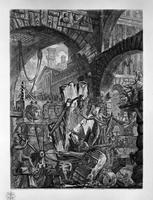
The Man on the Rack
Giovanni Battista Piranesi
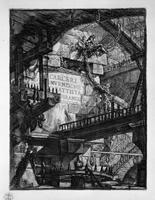
Title Plate
Giovanni Battista Piranesi
A Friar Tempted by Demons
Salvator Rosa
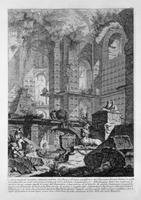
Burial chamber invented and designed in accordance with the custom and the ancient Roman emperors magnificence
Giovanni Battista Piranesi
The Prisons (plate IV)
Giovanni Battista Piranesi
Antenna dark prison
Giovanni Battista Piranesi
View of the Colosseum
Joseph-Marie Vien
Ruins of an ancient tomb placed before other ruins of an aqueduct
Giovanni Battista Piranesi
The Staircase with Trophies
Giovanni Battista Piranesi
The Roman antiquities, t. 1, Plate XXV. Nero`s aqueduct.
Giovanni Battista Piranesi