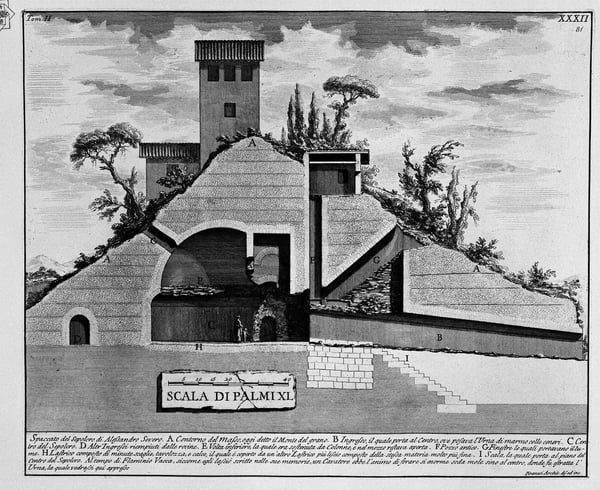
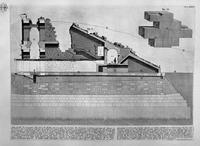
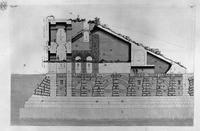
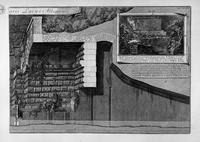
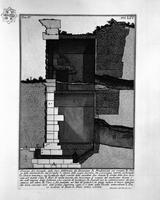
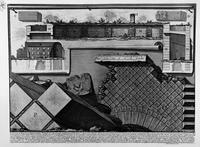
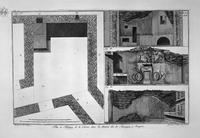
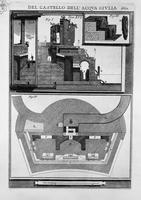
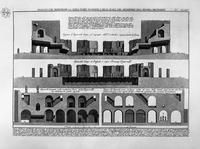
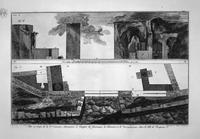
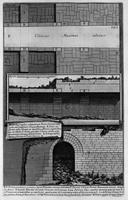
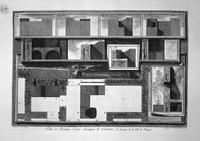
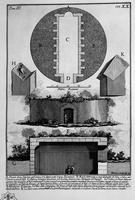
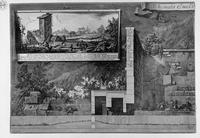
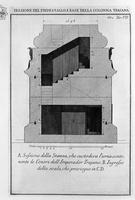
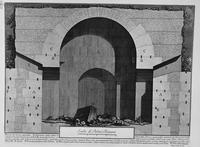
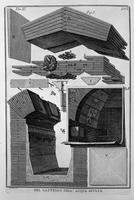
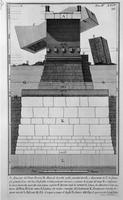
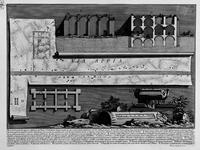
This plate by Giovanni Battista Piranesi, part of his monumental series The Roman Antiquities, exemplifies the Neoclassical synthesis of archaeological precision and artistic grandeur. As a work of design, it serves both as a scholarly record and an imaginative reconstruction of the tomb of the Roman emperor Alexander Severus, located outside the Porta San Giovanni in Rome.
Piranesi’s rendering combines a meticulous ground plan with an external elevation, a format that underscores the Neoclassical commitment to clarity, order, and the rational study of antiquity. The planar view diagrams the structural layout, while the perspective view brings the ruin to life with dramatic shadows, textured stone, and atmospheric decay—signature elements of Piranesi’s style. This duality reflects the era’s pursuit of both archaeological authenticity and the sublime emotional power of ancient remains.
The significance of this work lies in its role as a bridge between art and science. During the 18th-century Neoclassical revival, Piranesi’s etchings were instrumental in disseminating knowledge of Roman architecture across Europe, influencing architects, designers, and patrons. By meticulously documenting the tomb’s form and situating it within the landscape (near the aqueducts he so often celebrated), Piranesi reinforced the Neoclassical ideal of architecture as a timeless, universal language rooted in classical precedent.
Furthermore, this plate demonstrates Piranesi’s unique contribution: he did not merely copy ruins but reinterpreted them with dramatic chiaroscuro and compositional dynamism, transforming archaeological documentation into compelling visual narratives. In so doing, he elevated the design genre from technical illustration to high art, leaving an enduring legacy that shaped both the aesthetics and the scholarship of the Neoclassical movement.