Analisi esperta di Ecce Homo di Maerten van Heemskerck
Stile: Mannerism (Late Renaissance) · Genere: religious painting
As an expert art historian, I will analyze the artwork Ecce Homo by Maerten van Heemskerck based solely on the provided facts: it belongs to the Mannerism (Late Renaissance) style and is a religious painting.
Significance within Mannerism (Late Renaissance):
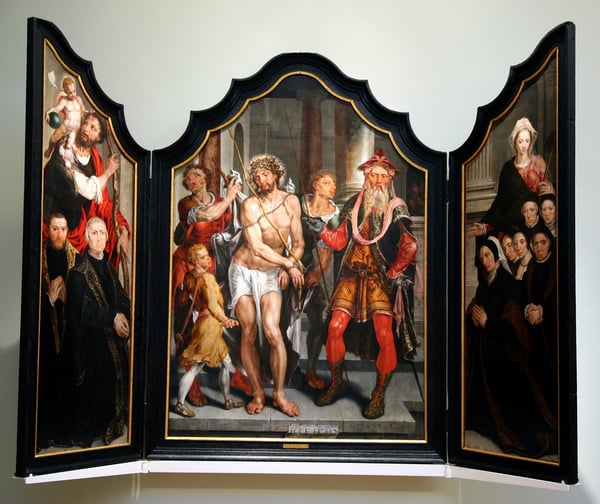
Maerten van Heemskerck’s Ecce Homo is a significant example of Northern Mannerist religious painting, particularly for its embodiment of the style’s characteristic artificiality, emotional tension, and complex spatial arrangement. As a Mannerist work, it moves away from the balanced harmony of the High Renaissance toward a more deliberately unsettling and theatrical presentation.
The painting captures the moment when Pontius Pilate presents the scourged Christ to the crowd with the words “Ecce Homo” (“Behold the Man”). Within the Mannerist idiom, this scene allows for intense emotional and compositional drama. Key features that make this work significant include:
-
Elongated and Contorted Figures: Mannerism is known for its figure style—bodies are often stretched, posed in artificial or twisted contrapposto, and arranged in a serpentine (figura serpentinata) manner. In van Heemskerck’s rendering, Christ is typically shown with an exaggerated, vulnerable fragility, while his tormentors and the crowd are depicted with angular, often grotesque gestures that heighten the psychological impact.
-
Spatial Compression and Complexity: The composition often employs a crowded, shallow foreground with little atmospheric depth, pressing the figures toward the picture plane. This creates a claustrophobic, confrontational effect that forces the viewer into the role of the crowd, directly witnessing Christ’s humiliation. Van Heemskerck uses architectural elements (such as a balustrade or pilasters) to both frame the scene and further compress the space, a hallmark of Mannerist intellectualism.
-
Artificial Color and Light: Mannerist palettes frequently feature discordant, acidic, or pastel-like hues—iridescent pinks, sharp greens, and unnatural flesh tones—that undermine naturalism. The lighting is often harsh and spot-lit, emphasizing the theatrical nature of the scene rather than a believable source.
-
Emotional and Intellectually Charged Narrative: Rather than simply illustrating a biblical story, van Heemskerck’s Ecce Homo typifies Mannerism’s interest in the virtuosic display of the artist’s skill (difficult poses, intricate drapery, detailed armor) and the elicitation of a visceral response. The religious subject is treated with a heightened sense of pathos and cruelty, aligning with the Counter-Reformation’s call for emotionally immediate devotional art.
In summary, this Ecce Homo is significant as a prime northern European example of Mannerist religious painting, demonstrating the style’s deliberate departure from Renaissance naturalism through its strained figures, compressed space, and intense emotional rhetoric—all deployed to make a familiar biblical moment feel newly disturbing and immediate.
Museum / Gallery
Visivamente simili
20 opere con composizione e palette affini
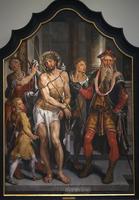
Ecce Homo - central panel
Maerten van Heemskerck
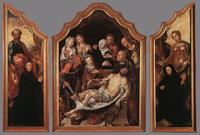
Triptych of the Entombment
Maerten van Heemskerck
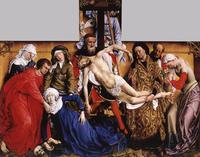
Deposition
Rogier van der Weyden
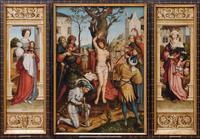
The Martyrdom of Saint Sebastian (Sebastiansaltar)
Hans Holbein the Elder
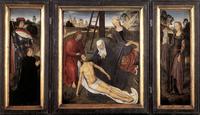
Triptych of Adriaan Reins
Hans Memling
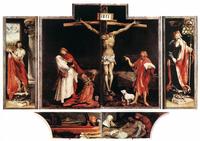
The first view of the altar: St. Sebastian (left), The Crucifixion (central), St. Anthony (right), Entombment (bottom)
Matthias Grünewald
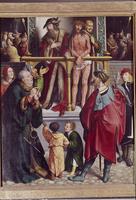
Ecce Homo
Jan Joest
Descent from the Cross, left hand panel from the Deposition Diptych
Hans Memling
Altar of Recanati polyptych, crowning the main board: Angel Pietà
Lorenzo Lotto
Pieta with portraits of Henry van Dondelberghe and wife
Gaspar de Crayer
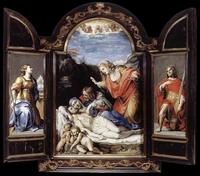
Triptych
Annibale Carracci
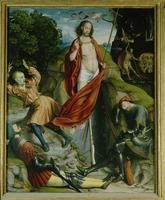
Resurrection of Jesus
Jan Joest
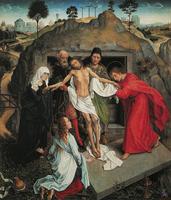
Lamentation of Christ
Rogier van der Weyden
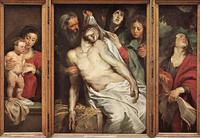
Lamentation of Christ
Peter Paul Rubens
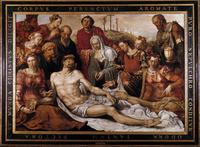
Lamentation on the Dead Christ
Maerten van Heemskerck
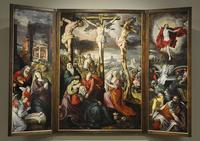
Drieluik Met Kruisiging, Geboorte En Verrijzenis Van Christus
Maarten de Vos
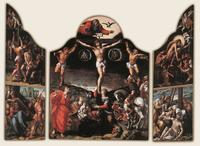
Altarpiece of Calvary
Bernard Van Orley
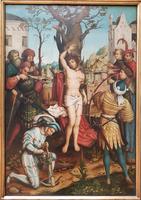
Das Martyrium Des Hl. Sebastian (Sebastiansaltar)
Hans Holbein the Elder
Kaisheimer Altar
Hans Holbein the Elder
Altar of St. John the Baptist
Hans Baldung