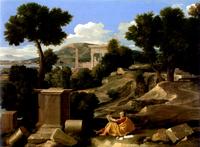
Expert Analysis of "Landscape with St. Jerome" by Maerten van Heemskerck
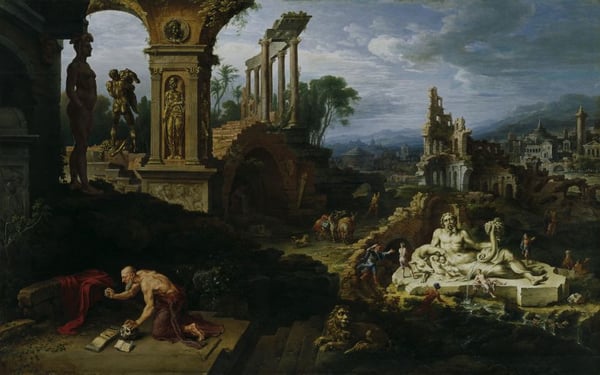
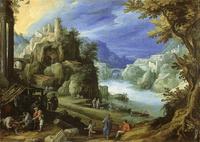
As a Mannerist religious painting from the Late Renaissance, this work exemplifies a crucial transition in Northern European art: the fusion of Italianate Mannerist sophistication with the Netherlandish love of intricate landscape. Van Heemskerck, after his return from Italy, consistently employed the contrapposto and elongated, serpentine figures typical of Mannerism—St. Jerome’s attenuated form and dramatic gesture are hallmarks.
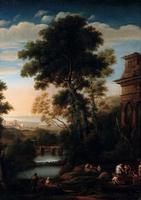
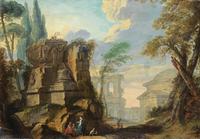
The significance lies in his subversion of traditional religious hierarchy: instead of placing the saint prominently in the foreground, Heemskerck embeds him within an expansive, almost overwhelming landscape. This reflects the Mannerist penchant for horror vacui (fear of empty space) and complex, artificial compositions. The twisting rocks, gnarled trees, and distant ruins are not mere backdrop but active participants in a chaotic, sublime nature, echoing the Counter-Reformation’s emphasis on ascetic contemplation against a fallen world.
Thus, the painting is significant as a bold synthesis—where Northern empirical landscape tradition meets Italian Mannerist artifice—creating a tour de force of intellectual and emotional tension that defines late 16th-century religious art.