Expertenanalyse zu Pyotr Konchalovskys Still Life with a jug
Stil: Post-Impressionism · Genre: still life
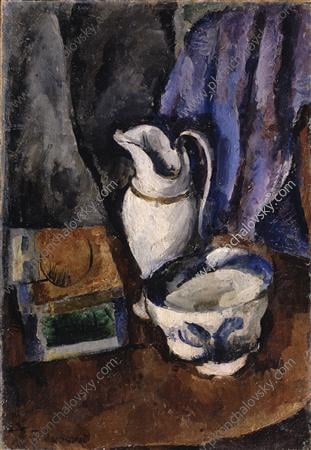
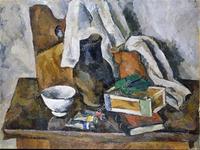
As an expert art historian analyzing "Still Life with a Jug" by Pyotr Konchalovsky, we can immediately place this work within the Post-Impressionist tradition, specifically through the lens of still-life painting. What makes this artwork significant is how it embodies the core Post-Impressionist shift away from the fleeting, atmospheric effects of Impressionism toward a more structured, emotionally resonant, and autonomous use of color and form.
In this still life, Konchalovsky demonstrates a deliberate emphasis on compositional solidity and material weight. The jug, likely a central motif, is not merely a vessel but a sculptural presence, rendered with bold outlines and thick, expressive brushstrokes that emphasize its volume and tactile surface. This reflects Post-Impressionism’s debt to Paul Cézanne, who taught that still life could be a vehicle for exploring underlying geometric structures and the tension between flatness and depth. Konchalovsky pushes this further by employing a vibrant, unmodulated palette—rich reds, deep blues, and earthy tones—that creates a sense of immediacy and emotional intensity, rather than naturalistic imitation.
The significance also lies in the treatment of space and light. Unlike Impressionist works where light dissolves objects, here the jug and surrounding elements (fruits, cloth, tabletop) are defined by strong color contrasts and simplified planes. The background is often compressed, reducing atmospheric depth and forcing the viewer to focus on the relationships between objects—a hallmark of Post-Impressionist still life that anticipates later abstraction. Konchalovsky’s brushwork is robust and gestural, adding a dynamic, almost rugged energy that transforms a mundane domestic scene into a statement about painting itself.
Within the broader Post-Impressionist movement, "Still Life with a Jug" stands as a testament to the Russian reception of French avant-garde ideas. Konchalovsky, a leading figure in the Russian avant-garde, adapts Western Post-Impressionism (particularly Cézanne and the Fauves) to a distinctly vigorous, earthy sensibility. The work is significant because it demonstrates how still life—often considered a lesser genre—became a laboratory for formal innovation: the jug becomes a study in color harmony, compositional balance, and the artist’s subjective vision. In essence, this painting exemplifies Post-Impressionism’s drive to elevate everyday objects through structural clarity, expressive color, and a palpable sense of the artist’s hand.
Visuell ähnlich
20 Werke mit ähnlicher Komposition und Farbpalette
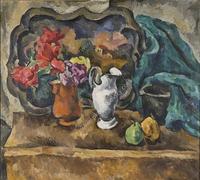
Still Life. Tray and flowers.
Pyotr Konchalovsky
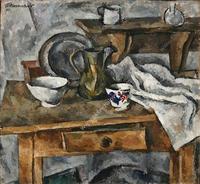
Still Life. Table with the dishes.
Pyotr Konchalovsky
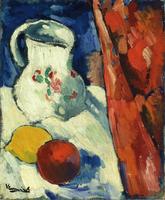
Still Life with Pitcher and Fruit
Maurice de Vlaminck
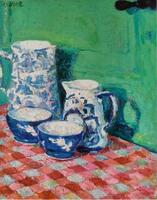
Nu Allongé Sur Le Ventre
Bela Czobel
Small Jar
Henri Matisse
House of Venus IV
Rosemarie Beck
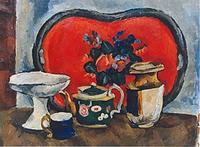
Still Life with a red tray.
Pyotr Konchalovsky
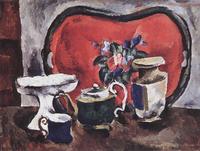
Still Life with a red tray
Pyotr Konchalovsky
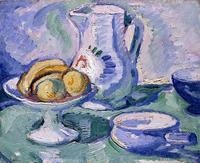
Jug and Yellow Fruit
Samuel Peploe
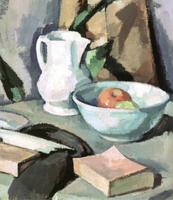
Still Life with a Jug and a Bowl of Apples
Samuel Peploe
Still life with jug
Pyotr Konchalovsky
Still Life with Jug
Bela Czobel
Still Life
Kmetty János
Vessels on the red tablecloth
Pyotr Konchalovsky
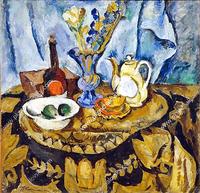
Still Life with a Coffeepot
Pyotr Konchalovsky
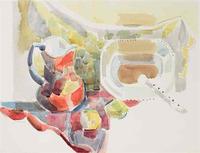
Modernist Still Life with Recorder
Robert Blackburn
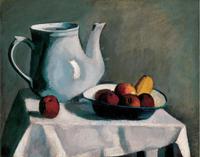
Bereny Robert, Still Life 1910
Berény Róbert
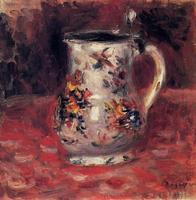
Jug
Pierre-Auguste Renoir
Still Life with Jug and Grapes
Samuel Peploe
Still Life with Apples
Paul Cezanne