
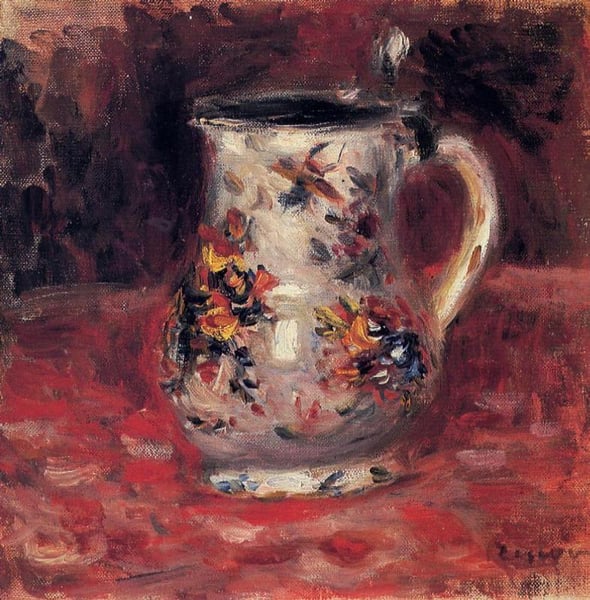
Analisi esperta di Jug di Pierre-Auguste Renoir
Stile: Impressionism · Genere: still life
Expert Analysis of "Jug" by Pierre-Auguste Renoir
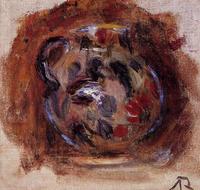
Pierre-Auguste Renoir’s Jug is a compelling example of how Impressionist principles transform even the most humble still-life subject into a vibrant study of light, color, and atmosphere. Although Renoir is celebrated primarily for his luminous figures and lively social scenes, this work reveals his mastery of the still-life genre within the Impressionist idiom.
Significance within the Impressionist Canon
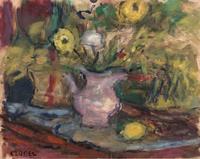
What makes Jug notable is its departure from the traditional, highly polished still lifes of the 19th-century academic salon. Instead, Renoir applies the hallmark Impressionist techniques of broken brushwork and an emphasis on the fleeting effects of light. The jug is not rendered with rigid contour lines or fine detail; rather, its form emerges through patches of color and reflected highlights. The surface of the pot catches specular reflections, likely from a window or a nearby cloth, demonstrating Renoir’s fascination with how light dances across surfaces.
Color and Atmosphere
Renoir’s palette in this work is characteristically warm and harmonious—soft creams, ochres, and touches of pale blue or lavender suggest an ambient, sunlit interior. By avoiding stark black shadows and instead using complementary hues (e.g., touches of violet in the shadows of the earthenware), he creates a sense of vibrancy and airiness. This chiaroscuro of color is a key Impressionist innovation.
The Everyday Elevated
The subject—a simple jug—might seem unremarkable, but in Renoir’s hands it becomes a vehicle for perceptual exploration. He treats the object not as a symbolic or moral emblem (as in Dutch vanitas still lifes) but as a pure visual phenomenon. The jug’s rounded body and handle are simplified to basic geometric masses, yet the handling of paint is anything but static. Visible, overlapping dabs of pigment give the surface a lively, tactile quality that invites the viewer to experience the act of seeing itself.
Conclusion
Jug stands as a testament to the Impressionist belief that any subject, no matter how ordinary, can be transfigured by the artist’s perception of light and color. In this work, Renoir demonstrates that still life is not a secondary genre but a rich field for the same radical optical experiments that define his portraits and landscapes. It is a quiet but masterful example of how Impressionism reshaped our understanding of pictorial space and sensation.
Museum / Gallery
Visivamente simili
20 opere con composizione e palette affini
Pitcher
Pierre-Auguste Renoir
Jug
Pierre-Auguste Renoir
Pitcher
Pierre-Auguste Renoir
Earthenware Jug
Pierre-Auguste Renoir
Still Life with Pitcher and Fruit
Maurice de Vlaminck
Nu Allongé Sur Le Ventre
Bela Czobel
House of Venus IV
Rosemarie Beck
Roses
Samuel Peploe
Watering Can
Pierre-Auguste Renoir
The Rose in Vase of Sassonia
Giovanni Boldini
Still Life with a red tray.
Pyotr Konchalovsky
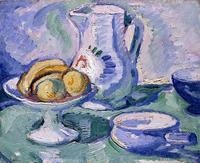
Jug and Yellow Fruit
Samuel Peploe
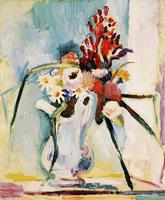
Flowers in a Pitcher
Henri Matisse
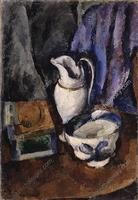
Still Life with a jug
Pyotr Konchalovsky
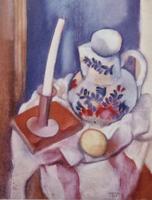
Vajda Lajos Still Life with Candles,1928 Pastell on Paper 64.5x45cm
Vajda Lajos
Still Life with Apples and Flowers
Gheorghe Petrascu
Small Jar
Henri Matisse
Scheiber Hugó, Csendélet Rózsákkal
Scheiber Hugó
Flowers
Umberto Veruda
Bela Czobel Adalbert. Flower in Vase
Bela Czobel