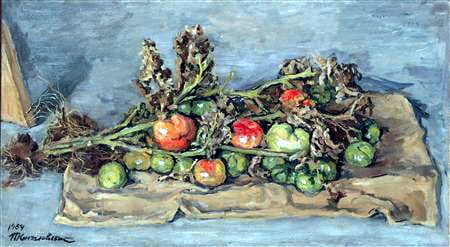
Analisi esperta di Still Life. Tomatoes on the bag. di Pyotr Konchalovsky
Stile: Realism · Genere: still life
Expert Art Historical Analysis
Pyotr Konchalovsky’s Still Life. Tomatoes on the bag. stands as a compelling example of early 20th-century Russian realism, a period when the artist deliberately pivoted from avant-garde experimentation toward a more grounded, tactile engagement with the physical world. Painted within the context of Konchalovsky’s post-“Jack of Diamonds” phase, this work is significant for its synthesis of modernist compositional boldness with a rigorous commitment to verisimilitude—a hallmark of the nuanced realism emerging in Russia during the 1910s–1920s.
Composition and Materiality
The painting’s primary innovation lies in its choice of support: the humble, textured bag as a makeshift tablecloth. Konchalovsky exploits the coarse fabric’s folds and creases to create a dynamic, almost sculptural ground, counterbalancing the organic roundness of the tomatoes. This decision elevates a mundane, perishable surface to a formal element—a move that echoes Cézanne’s respect for everyday objects but grounds the composition in a distinctly Russian, unpretentious sensibility. The tomatoes themselves are rendered with dense, earthy brushwork; their skins appear taut and translucent, capturing the play of light on their curved forms. Each fruit asserts its individual weight and ripeness, arranged not in a sterile pyramid but in a casual, almost accidental cluster that suggests a moment of everyday life.
Significance as Realism
Konchalovsky’s approach here distances himself from the decorative flatness and chromatic excess of his earlier Fauvist-inspired works. Instead, he embraces a realism that is neither photographic nor sentimental. The painting’s significance lies in how it marries volumetric solidity (the tomatoes) with textural impermanence (the crumpled bag), creating a dialogue between permanence and transience. This tension is central to the realist still life tradition: the objects are palpable yet poised on the verge of decay, reminding the viewer of material mortality.
Legacy and Period Context
Within the broader realist movement, Konchalovsky’s Tomatoes on the bag is noteworthy for its refusal to romanticize peasant or domestic life—unlike the later Socialist Realist canon. Instead, it offers a quiet, introspective realism that values the intrinsic beauty of simple forms and honest materials. The painting anticipates the later Soviet “severe style” in its unsentimental directness, while retaining a painterly confidence that links it to the European post-impressionist tradition. Ultimately, the work’s significance lies in its ability to transform the everyday into a site of profound visual inquiry, affirming Konchalovsky’s role as a master of the still life genre who redefined realism for a modern age.
Visivamente simili
20 opere con composizione e palette affini
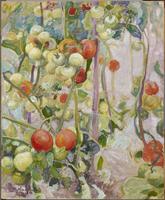
Tomater
Pekka Halonen
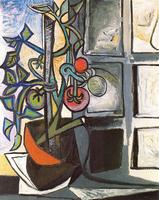
Tomato plant
Pablo Picasso
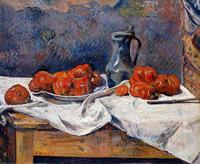
Tomatoes and a pewter tankard on a table
Paul Gauguin
Tomates
Javier Ibarrondo Los Arcos
Knife + Tomato I
Richard Diebenkorn
Tomato and Knife
Richard Diebenkorn
Le debut du jour
Nicolae Maniu
Vaszary János, Asztali Csendélet 1926
Vaszary János
A still life with vegetables
Constant Permeke
Still Life
Pierre-Auguste Renoir
Still Life Apples Vase
Maurice Prendergast
Jug and Tomatoes
Nathan Altman
Still Life With Vegetables
Adam Baltatu
Still Life
Salvador Dali
Still Life with Tomatoes and Pitcher
George Bouzianis
Melon and Tomatos
Pierre-Auguste Renoir
Still Life with Basket of Apples (to Lucien Pissarro)
Vincent van Gogh
Still Life
Maurice Prendergast
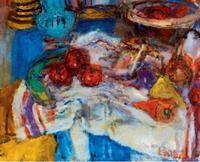
Czóbel Béla ,csendélet
Bela Czobel
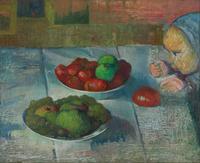
Still life with a profile of Mimi
Meijer de Haan