
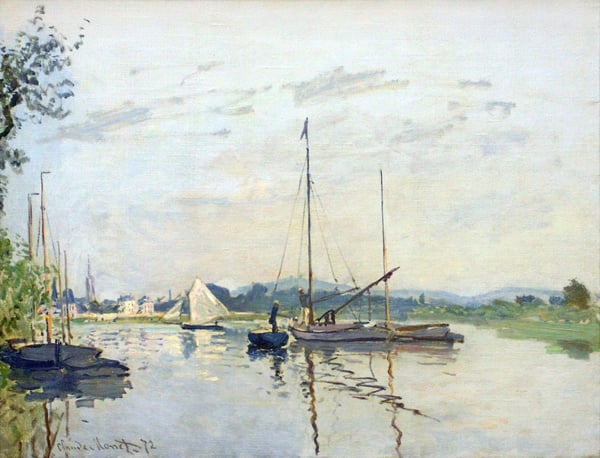
Deskundige analyse van Argenteuil van Claude Monet
Stijl: Impressionism · Genre: landscape
Expert Art Historical Analysis: Argenteuil by Claude Monet (c. 1872–1875)
As a quintessential Impressionist landscape, Argenteuil exemplifies Claude Monet’s revolutionary approach to capturing the transient effects of light and atmosphere. Painted during his most productive period in the suburban Seine town of Argenteuil—a haven for Parisian leisure and industry—the work transforms a seemingly ordinary riverside scene into a vibrant, sensory experience.
Significance within Impressionism:
Monet’s handling is the core of the painting’s innovation. Using short, broken brushstrokes of pure, unmixed color, he abandons traditional modeling and linear perspective. Instead, the composition is built from shimmering patches of blue, green, white, and warm ochre that coalesce only when viewed from a distance. The reflections in the water are rendered with equal weight to the solid forms of the boats and trees, blurring the boundary between reality and its mirror. This technique directly challenges academic conventions of finish and draws attention to the act of perception itself.
Atmospheric Capture:
The painting likely depicts a specific, fleeting moment—perhaps a hazy summer afternoon or a windy morning—as evidenced by the play of sunlight on the Seine’s surface and the rippling reflections. Monet’s choice of Argenteuil is deliberate: the town was both a modern industrial hub (with factories and railway bridges) and a picturesque retreat. The sailboats and leisure activities subtly comment on the changing social landscape of 1870s France, where the middle class sought recreation along newly accessible waterways.
Why It Matters:
Argenteuil is emblematic of Impressionism’s radical shift from narrative history painting to the pure pictorial record of a modern, ephemeral world. Monet’s emphasis on direct observation, broken color, and light-as-subject laid the groundwork for subsequent movements like Post-Impressionism and helped redefine the very purpose of landscape art: not as a literal transcription, but as a visual equivalent of a lived moment. The work remains a masterclass in how formal innovation—here, the dissolution of form into colored light—can convey the poetry of everyday life.
Visueel vergelijkbaar
20 werken met verwante compositie en kleurenpalet
Pleasure Boats, Argenteuil, c.1872-3 (oil on canvas)
Claude Monet
Boats on the Seine at Argenteuil
Gustave Caillebotte
Boats in a Harbour, Ostende
Constant Permeke
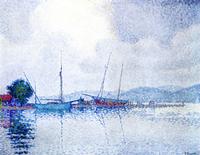
Saint Tropez, after the storm
Paul Signac
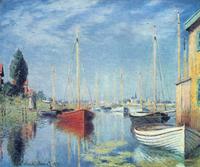
Yachts At Argenteuil
Claude Monet
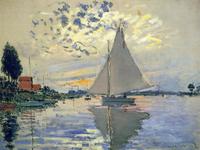
Sailboat at Le Petit-Gennevilliers
Claude Monet
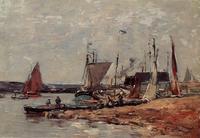
Trouville, the Port
Eugene Boudin
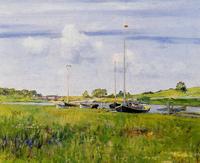
At the Boat Landing
William Merritt Chase
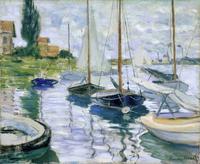
Boats at rest, at Petit-Gennevilliers
Claude Monet
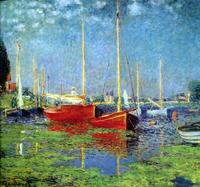
Argenteuil
Claude Monet
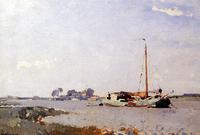
Ships On A Puddle
Cornelis Vreedenburgh
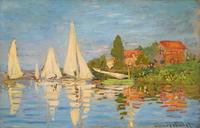
Regatta at Argenteuil
Claude Monet
Trouville, the Jettys at Low Tide
Eugene Boudin
Seehafen
Eugene Boudin
Fishermen mending nets
Alfred Sisley
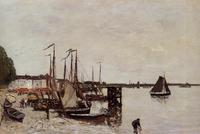
Antwerp, Fishing Boats
Eugene Boudin
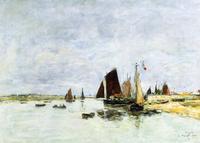
Etaples, Boats in Port
Eugene Boudin
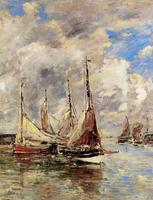
Trouville. The Jettys High Tide.
Eugene Boudin
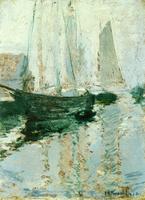
Gloucester Boats
John Henry Twachtman
Rowing on the river
Johan Hendrik Weissenbruch