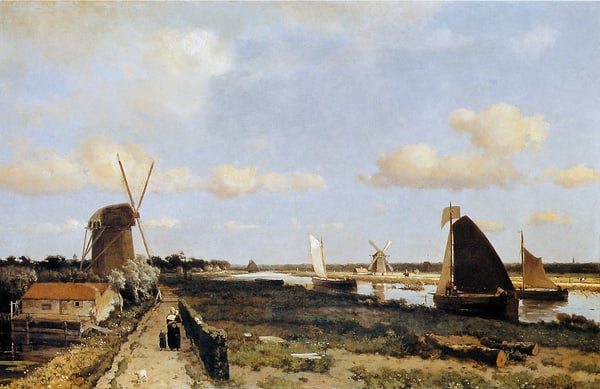
View at Geestbrug
Expert analysis of Johan Hendrik Weissenbruch’s View at Geestbrug
Style: Realism · Genre: landscape
Expert Analysis: "View at Geestbrug" by Johan Hendrik Weissenbruch
Johan Hendrik Weissenbruch (1824–1903) was a central figure of the Hague School, the Dutch Realist movement that emerged in the mid‑19th century. His work, rooted in the tradition of 17th‑century Dutch landscape painting, broke decisively from Romantic conventions by embracing a naturalistic, unidealized vision of the countryside. "View at Geestbrug" exemplifies this shift, capturing a seemingly mundane stretch of polder landscape near the village of Geestbrug (now part of Rijswijk, near The Hague) with extraordinary sensitivity to light, atmosphere, and spatial recession.
Significance within Realism and the Hague School:
-
Atmospheric Truth: Weissenbruch was renowned for his virtuoso treatment of the Dutch sky and water. In View at Geestbrug, the low horizon and vast, cloud‑filled sky dominate the composition. The moist, hazy atmosphere that typifies the Low Countries is rendered through delicate gradations of gray, silver, and muted blue—a hallmark of Hague School Realism. This focus on fleeting weather and the play of light on damp ground aligns with the movement’s goal of capturing “the mood of the landscape” rather than a heroic or picturesque narrative.
-
Everyday Subject Raised to Art: The scene is resolutely ordinary: a canal or waterway, a simple bridge (the “Geestbrug” or bridge over the Geest), flat fields, and a few trees or buildings in the distance. There are no dramatic mountains, sunsets, or historical references. Weissenbruch elevates this prosaic view by emphasizing structure—the strong horizontal lines of the dyke and water, the vertical accents of distant church spires—and by using a restrained, almost monochromatic palette that mirrors the muted light of the Dutch polder.
-
Technical Mastery within Realism: Weissenbruch’s brushwork is both precise and atmospheric. He builds the scene with a combination of broad, sweeping strokes for the sky and water, and more detailed touches for the bridge and vegetation. This technique, influenced by the Barbizon school but distinctly Dutch, creates a sense of depth and moisture that makes the viewer feel the cool, damp air. His ability to paint “the gray of the Netherlands” in all its tonal richness was celebrated by contemporaries and critics alike.
-
Cultural and Historical Context: The Hague School artists (including Jozef Israëls, Jacob Maris, and Anton Mauve) responded to the rapid industrialization and urban growth of the Netherlands by turning to the timeless, unchanging rural landscape. View at Geestbrug is thus not merely a landscape but a quiet assertion of Dutch identity—the enduring relationship between people, water, and land. Weissenbruch’s paintings, including this one, are recognized as among the most poetic and honest expressions of that bond.
-
Legacy: Weissenbruch’s work influenced later generations of Dutch landscape painters by proving that the most humble scenes could be made profound through faithful observation and painterly skill. View at Geestbrug stands as a quintessential example of how Realism, in the hands of its finest practitioners, achieves not just documentation but genuine emotional resonance—a stillness and grandeur found within the ordinary.
In sum, View at Geestbrug is significant because it distills the core principles of the Hague School Realism: a deep, respectful attention to the actual appearance of the Dutch landscape; a mastery of tonal subtlety and atmosphere; and the conviction that a simple bridge over a polder canal is as worthy of art as any grand vista. Weissenbruch’s ability to suffuse such a scene with quiet monumentality ensures his place as one of the Netherlands’ greatest 19th‑century landscape painters.
Visually similar
20 works with related composition and palette
Canal at Rijswijk
Johan Hendrik Weissenbruch
Towpath near The Hague
Johan Jongkind
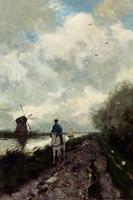
On The Tow Path Along The River Amstel
Johan Hendrik Weissenbruch
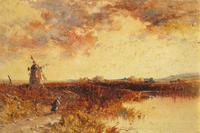
Scene with a Windmill
James Webb
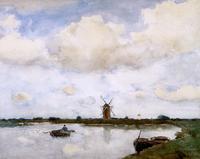
Mill at the lake
Johan Hendrik Weissenbruch
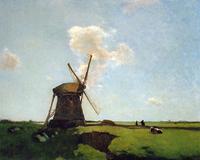
Polder landscape
Johan Hendrik Weissenbruch
Horseman on a tow path
Johan Hendrik Weissenbruch
Sailboats on the Wijkermeer
Salomon van Ruysdael
Holländische Landschaft
Julius van de Sande Bakhuyzen
View of Schiedam
Johannes Joseph Destrée
Boats on a River
Aelbert Cuyp
Ship in polder canal
Johan Hendrik Weissenbruch
Segelboote Auf Dem Wijkermeer
Salomon van Ruysdael
East Anglian River Landscape with Windmills and Church
Joseph Stannard
Study for View on Den Haag
Cornelis Springer
Summer Dutch river view with boats, cattle and figures
Johannes Joseph Destrée
Dutch river landscape
Gustav Schonleber
Lac et paysage, Hollande
Johannes Joseph Destrée
At Fordwich, Kent
Frederick George Cotman
Ships on canal
Johan Hendrik Weissenbruch