
Expert analysis of Philip Guston’s Sleeping
Style: Neo-Expressionism · Genre: genre painting
Expert Analysis of Philip Guston’s "Sleeping" (c. 1978–80)
Context & Stylistic Significance
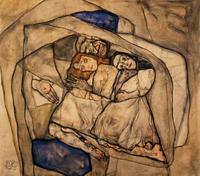
Philip Guston’s Sleeping is a defining work of his late, controversial return to figuration, which became a cornerstone of Neo-Expressionism in the 1970s and 1980s. After decades as a celebrated Abstract Expressionist, Guston shocked the art world in 1970 by abandoning abstraction for a crude, cartoon-like figurative style. Sleeping exemplifies this radical shift, using thick, gestural brushwork and a muted palette (blues, grays, and fleshy pinks) to depict a mundane, intimate scene—a figure dozing in bed. The work’s significance lies in how Guston transforms a genre painting motif (the everyday act of sleeping) into a loaded psychological tableau.
Formal Analysis & Anti-Illusionism
The painting rejects traditional perspective and idealized form. The sleeping figure is rendered with lumpy, distorted anatomy—bloated hands, a flattened face, and a heavy, inert body—as if the body itself is dissolving into the mattress. Guston’s loose, almost shaky brushstrokes and his use of strong outlines recall both comic strips and the raw urgency of Jean Dubuffet’s Art Brut. The bed’s rumpled sheets and a single lamp (often present in Guston’s interiors) create a claustrophobic, slightly sinister atmosphere. This is not a restful sleep but a troubled, existential suspension.
Themes and Psychoanalytic Underpinnings
Guston’s “sleeping” figures are recurring protagonists in his late oeuvre, often accompanied by hooded Klansmen or solitary objects. Here, the absence of such overt political symbols focuses attention on vulnerability and the unconscious. The painting can be read as a self-portrait of the artist wrestling with mortality, anxiety, and the creative process—a theme that connects to Guston’s earlier abstract “troubling” works. By elevating a private, passive act to monumental scale, Guston challenges the heroic masculinity of Abstract Expressionism and deliberately courts “bad painting” to express raw, unvarnished inner life.
Legacy in Neo-Expressionism
Sleeping is significant for its influence on later Neo-Expressionists like Julian Schnabel and Georg Baselitz, who similarly embraced figurative distortion and psychological rawness. Yet Guston’s work remains distinct for its sardonic, self-deprecating wit and its refusal to glamorize either abstraction or figuration. The painting reasserts the power of genre painting as a vehicle for modern existential crisis—a quiet, unsettling masterpiece that continues to resonate as a testament to artistic reinvention.
Museum / Gallery
Visually similar
20 works with related composition and palette
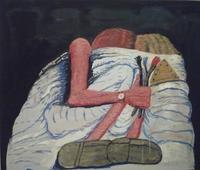
Couple in bed
Philip Guston
Sleeping girl II
Walter Gramatté
The dreaming
Paul Gauguin
Woman in bed (Sleeping girl)
Walter Gramatté
Night
Mykhailo Vainshtein
Two Girls on a Fringed Blanket
Egon Schiele
Sleeping Woman
Will Barnet
Resting
Vera Nedkova
Tribute to Byzantine masters
Chronis Botsoglou
Holy Apathy
Kateryna Lysovenko
The Blind
Egon Schiele
Reclining figure
Albert Bloch
Blanket
Boris Kustodiev
Czóbel Béla, Margerite 1920
Bela Czobel
Comforter
Catherine Murphy
Sketches of costumes for "Tale of Tsar Saltan"
Nicholas Roerich
Seated Girl
Egon Schiele
Reclining Girl on a Pillow
Egon Schiele
My hospital bed
Hubertine Heijermans
Conversion
Egon Schiele