Analisi esperta di Transition di Philip Guston
Stile: Neo-Expressionism · Genere: figurative
Analysis of "Transition" by Philip Guston
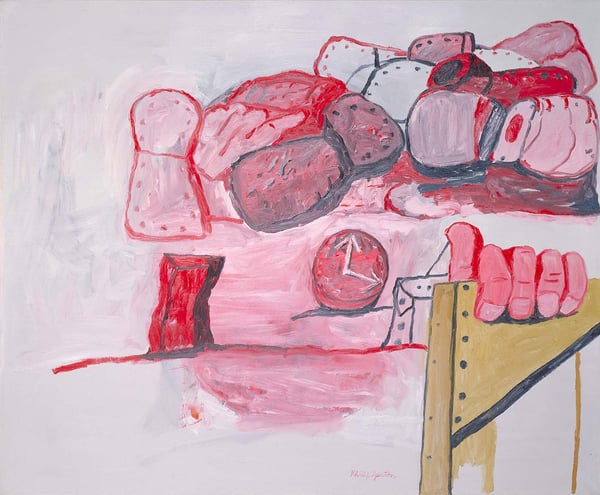
Philip Guston’s Transition stands as a powerful testament to his radical reinvention of figurative painting within the Neo-Expressionist movement. Created during the period when Guston abandoned the refined abstraction of his earlier career, this work exemplifies the raw, confrontational energy that defines Neo-Expressionism. The painting’s significance lies not in a single narrative, but in its role as a pivot point—a visual declaration that the human figure could again carry the weight of existential and political anxiety after decades of abstract dominance.
Art-Historical Context and Breakthrough Guston’s move to a figurative, almost cartoonish style in the late 1960s and early 1970s shocked the art world. Transition embodies this rupture. By returning to the figure—albeit in a deliberately crude, clumsy manner—Guston rejected the purity of Abstract Expressionism and instead embraced a Neo-Expressionist idiom that prioritized emotional immediacy over formal grace. This work helped legitimize figuration as a vehicle for complex personal and social commentary in a postmodern era.
Visual and Thematic Significance While specific visual details of Transition are not provided, Guston’s signature Neo-Expressionist approach would typically employ thick, gestural brushwork, a muted but gritty palette (often blacks, grays, pinks, and reds), and distorted, weighty forms. The title “Transition” likely signals a moment of change—perhaps the artist’s own shifting identity, or a broader passage between states of being. Guston’s figures often inhabit confined, oppressive spaces (rooms, windows, cityscapes) that feel both real and dreamlike, suggesting the psychological tension of modern life. The crudeness of the rendering becomes a formal expression of vulnerability and doubt, making the work significant as a meditation on the struggle to communicate meaning through paint.
Legacy Transition is significant as a cornerstone of Guston’s late period, which influenced generations of Neo-Expressionist and figurative painters (e.g., Georg Baselitz, Julian Schnabel). It demonstrates that figurative art can be as radical, personal, and intellectually rigorous as abstraction. The work remains a key example of how Neo-Expressionism revitalized the painted surface as a site for raw, subjective truth-telling.
Visivamente simili
20 opere con composizione e palette affini
Painting, Smoking, Eating
Philip Guston
Room
Philip Guston
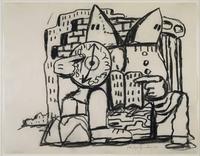
Untitled
Philip Guston
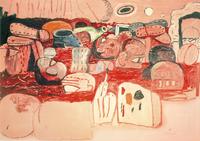
Deluge II
Philip Guston
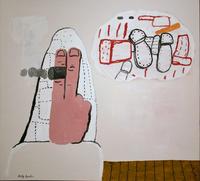
Daydreams
Philip Guston
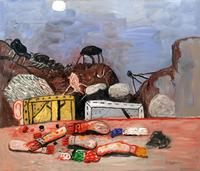
Moon
Philip Guston
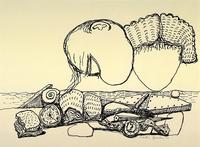
Hovering
Philip Guston
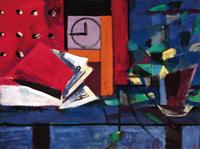
The Clock
Karl Knaths
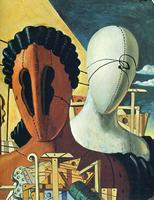
The Two Masks
Giorgio de Chirico
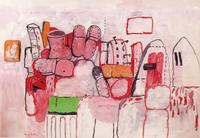
Days Work
Philip Guston
Connecticut Clock
Karl Knaths
Times and places
Jean Dubuffet
The Pit
Philip Guston
He wasn't 18 1974
Alekos Kontopoulos
Bad habits
Philip Guston
Shaking Out the Bed
Dana Schutz
Symposium
Anima Ehtiat
The Street
Philip Guston
Web
Philip Guston
Natureza morta com três vasos de cactos
Lasar Segall