
Analisi esperta di Canto XVIII di Barnett Newman
Stile: Color Field Painting · Genere: abstract
Expert Analysis of Canto XVIII (1963) by Barnett Newman
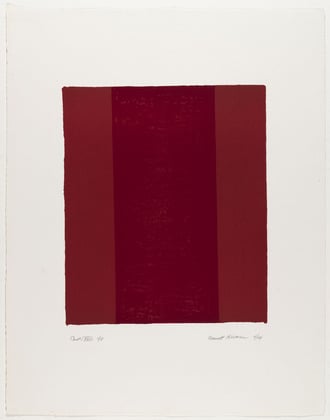
Barnett Newman’s Canto XVIII is a landmark work of Color Field painting, a movement that emerged from Abstract Expressionism in the 1950s and 1960s. Newman’s contribution to this style is defined by his radical simplification of form and his pursuit of the sublime through pure color and space.
Formal Elements and Innovation
The painting belongs to Newman’s Canto series, which draws its title from Dante’s Divine Comedy—specifically the epic poem’s cantos, or sections. Like all of Newman’s mature works, Canto XVIII features a vast, unmodulated field of color (here, a deep, resonant red or blue, depending on the specific version) bisected by one or more thin, vertical “zips.” These zips are not lines but rather bands of contrasting color that create a dynamic tension between the field and the stripe. The scale of the work is monumental, enveloping the viewer in a sensory experience that rejects traditional composition or narrative.
Significance within Color Field Painting
Newman’s Canto paintings exemplify the core tenets of Color Field painting: the use of large, flat areas of color as the primary carrier of meaning, the elimination of brushstroke and gesture, and the emphasis on the viewer’s physical relationship to the canvas. Unlike the aggressive, spontaneous paint-handling of Abstract Expressionists such as Jackson Pollock, Newman’s surfaces are stark, smooth, and deliberate. The “zip” becomes a charged event—a moment of rupture or revelation that animates the otherwise silent field. This approach influenced later Color Field artists like Mark Rothko (who also sought the sublime but through softer, blurred edges) and Kenneth Noland.
Thematic and Philosophical Depth
Canto XVIII is not merely an abstract arrangement; it is a meditation on creation, space, and the infinite. Newman described his zips as “a kind of passage” or “a path through space,” evoking both the dividing line between two worlds and the act of creation itself. The title Canto alludes to a structured, poetic sequence, yet the painting resists any literal narrative. Instead, it invites the viewer to experience a moment of pure presence—a sublime encounter between the self and the artwork that Newman called the “sublime in painting.” This work, typical of his output from the early 1960s, consolidates his reputation as a pioneer who pushed abstraction toward a spiritual, almost ritualistic dimension.
Legacy
Canto XVIII stands as a quintessential example of how Color Field painting transcends decoration to become a vehicle for existential and metaphysical inquiry. Newman’s insistence on the “zip” as a defining feature of his style—and his ability to make a single vertical line feel like a cosmic event—cements this work’s significance in the history of 20th-century abstraction.
Visivamente simili
20 opere con composizione e palette affini
Canto XVI
Barnett Newman
Canto XIV
Barnett Newman
Canto XV
Barnett Newman
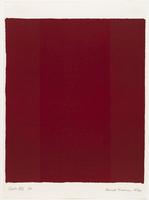
Canto XVII
Barnett Newman
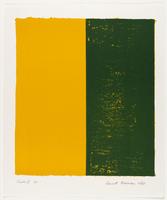
Canto X
Barnett Newman
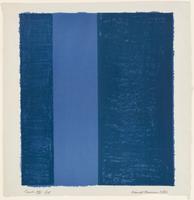
Canto VII
Barnett Newman
28.5.66
John Hoyland

Blue Column
Morris Louis
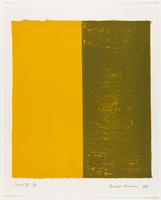
Canto XIII
Barnett Newman
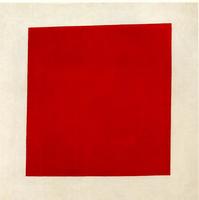
Red square
Kazimir Malevich
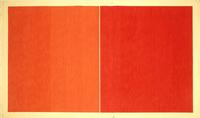
Red Baron
Gene Davis
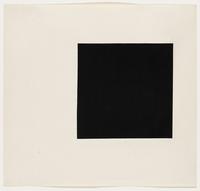
Square Form
Ellsworth Kelly
Blues, Reds
John Hoyland
Black-Green from the Series of Ten Lithographs
Ellsworth Kelly
Number 11
John McLaughlin
Untitled
Brice Marden
Untitled No. 5
Michael Heizer
Sevastipol
Doug Ohlson
Untitled
Gene Davis
Burnt Umber & Ultramarine Blue
Yun Hyong–keun