Agnolo Bronzino の Portrait of Andrea Doria as Neptune の専門的な分析
スタイル:Mannerism (Late Renaissance) · ジャンル:portrait
Expert Analysis: "Portrait of Andrea Doria as Neptune" by Agnolo Bronzino
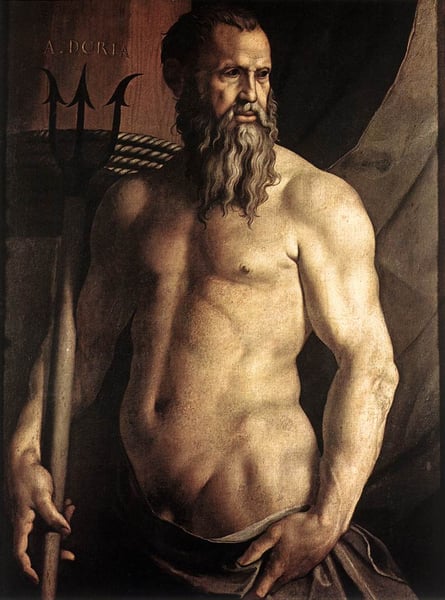
This work is a landmark of Mannerist portraiture, fusing the genre’s penchant for aristocratic elegance with mythological allegory. Painted by Agnolo Bronzino, the leading court portraitist of the Medici, it transforms the Genoese admiral Andrea Doria into the god of the sea, Neptune. The significance lies in how Bronzino uses Mannerist conventions—elongated forms, cool polish, and intellectual conceit—to glorify Doria’s naval prowess and political status.
Stylistic Hallmarks of Mannerism
Bronzino’s handling epitomizes the Mannerist break from High Renaissance naturalism. Doria’s body is idealized and elongated, with sinuous, almost serpentine contours that create a sense of poised tension. The palette is typically cool and refined: silvery-greens, blues, and pale flesh tones, applied with a smooth, enamel-like finish that renders the skin as flawless marble. Every detail—from the curling beard to the trident’s shaft—is meticulously delineated, emphasizing the artificial elegance prized by Mannerist courts.
Allegorical Innovation
Unlike a straightforward portrait, this work merges likeness with mythological role-play. Doria is shown nude except for a drape, wielding Neptune’s trident, with a ship in the background alluding to his command of the Genoese fleet. This visual metaphor elevates the sitter from historical figure to timeless icon of maritime power. Bronzino’s clever juxtaposition of realistic facial features (Doria’s weathered, authoritative face) with an idealized godly body creates a tension that is quintessentially Mannerist—intellectual, sophisticated, and deliberately artificial.
Significance Within the Period
The portrait exemplifies the Mannerist shift from religious to secular, courtly patronage. It is a celebration of individual glory through classical allegory, a device Bronzino mastered for the Medici court. The work’s cool sensuality and complex symbolism also influenced later Mannerist portraiture, reinforcing the genre’s focus on maniera (style) over mere likeness. Ultimately, “Portrait of Andrea Doria as Neptune” stands as a masterful synthesis of portrait and myth, showcasing Mannerism’s capacity to conflate human achievement with divine grandeur—a hallmark of Late Renaissance aristocratic self-fashioning.
Museum / Gallery
視覚的に類似
構図やパレットが近い作品 20 件
Saint Jerome
Bartolomeo Passerotti
Ecce Homo
Albrecht Durer
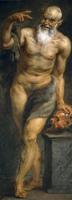
Satyr Peter
Peter Paul Rubens
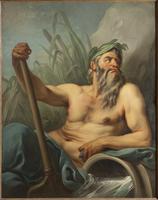
River God
Charles-Andre van Loo (Carle van Loo)
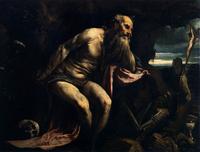
Saint Jerome
Jacopo Bassano
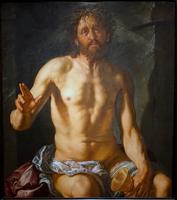
Man of Sorrows with a Chalice (Christ as Redeemer)
Hendrick Goltzius
Male Torso
Jean Auguste Dominique Ingres
Half Length Figure
William-Adolphe Bouguereau
Ecce Homo
Titian
Mercury
Hendrick Goltzius
Samson imprisoned
Annibale Carracci
Orpheus
Roberto Ferri
St. Jerome
Jan van Hemessen
Academic Nude
Xavier Mellery
St Jerome in the Wilderness
Guercino
Nude male
Colleen Barry
Saint Jerome
Anthony van Dyck
St Jerome near a Cave
Maarten de Vos
Nude male
Colleen Barry
Naked man with spear
Marià Fortuny