Expert analysis of Agnolo Bronzino’s Portrait of Bia de' Medici
Style: Mannerism (Late Renaissance) · Genre: portrait
Expert Analysis: "Portrait of Bia de' Medici" by Agnolo Bronzino
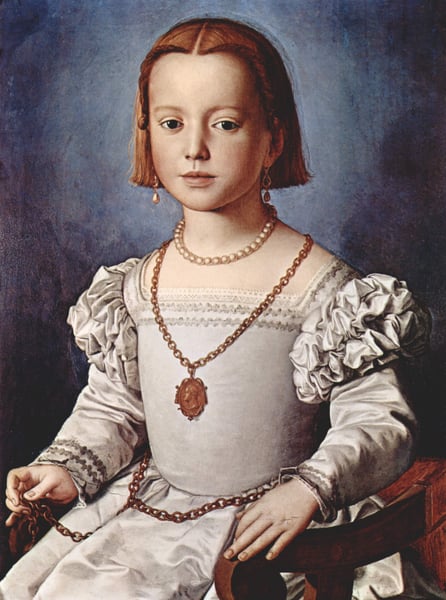
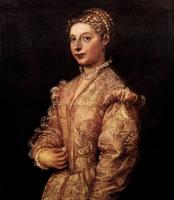
This work is a quintessential example of Mannerist portraiture—a late Renaissance style that prized elegance, artificiality, and intellectual sophistication over naturalism. Bronzino, the official court painter to Cosimo I de' Medici, created this portrait of the duke’s illegitimate daughter, who died at the age of five. The painting’s significance lies in how it transforms a straightforward portrait into a statement of dynastic power and Mannerist ideals.
Formal Characteristics and Mannerist Significance
Bronzino suppresses any sense of childhood spontaneity. Bia is depicted with an adult-like composure: her posture rigid, her gaze cool and direct, her skin rendered with a flawless, porcelain-like finish. This unnatural perfection is deliberate—Mannerism prized maniera (style) over mere imitation of nature. The intricate gold embroidery of her dress, the precise geometry of the jeweled necklace, and the deep, enamel-like background all emphasize surface artifice. The child’s face, though individualized, is idealized into a mask of serene detachment, a hallmark of Bronzino’s courtly language.
Symbolic and Contextual Weight
The portrait is not a record of a living child but a monument to a lost Medici heir. Bia’s premature death imbues the work with a poignant tension: the frozen, adult formality contrasts with her actual youth, underscoring the fragility of dynastic hopes. Bronzino’s handling of light—smooth, ambient, without dramatic shadow—creates an almost otherworldly stillness, as if the subject exists outside of time. This aligns with Mannerism’s fascination with the artificial and the eternal.
Placement in Art History
In the canon of Renaissance portraiture, this work stands apart for its cold, intellectual beauty. Unlike the warmer, more humanistic portraits of the High Renaissance (e.g., Leonardo or Raphael), Bronzino prioritizes style and courtly ritual over psychological depth. The Portrait of Bia de' Medici is thus a masterful demonstration of Mannerism’s core ambition: to elevate art into a refined, deliberate fiction—one that speaks of power, loss, and the eternal allure of perfection.
Museum / Gallery
Visually similar
20 works with related composition and palette
Lucrezia Panciatichi
Agnolo Bronzino
Portrait of a Girl
Gilbert Jackson
Portrait of a Young Lady
Johann Heinrich Tischbein the elder
Portrait of a Lady
Alessandro Allori
Eleanora da Toledo with her Son Giovanni
Agnolo Bronzino
Prinzessin Maria von Oranien-Nassau
Gerard van Honthorst
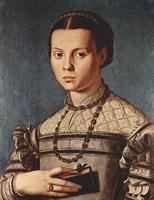
Portrait of a girl with book
Agnolo Bronzino
Maria Trip
Rembrandt
The Beauty
Titian
Eleonora Mauritia, prinses van Portugal
Gerard van Honthorst
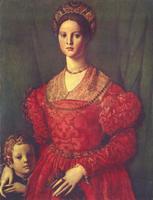
Portrait of young woman with her son
Agnolo Bronzino
Lady Margaret Hungerford
Cornelius Johnson

Portrait of an Unknown Lady
Cornelius Johnson
Bianca Capello De'Medici (possibly)
Alessandro Allori
Mogelijk Portret Van Sabina Delphica
Gerard van Honthorst
Anne Bateman, later Mrs. John Gisbourne
Joseph Wright
Portrait of Anna Bozzini Birti
Giuseppe Tominz
Portrait of Caterina Bozzini Buzzi
Giuseppe Tominz
Portrait of Eleonora Gonzaga
Titian
Portrait of a Girl
Titian