Agnolo Bronzino sanatçısının Portrait of Guidubaldo della Rovere eseri hakkında uzman analizi
Tarz: Mannerism (Late Renaissance) · Tür: portrait
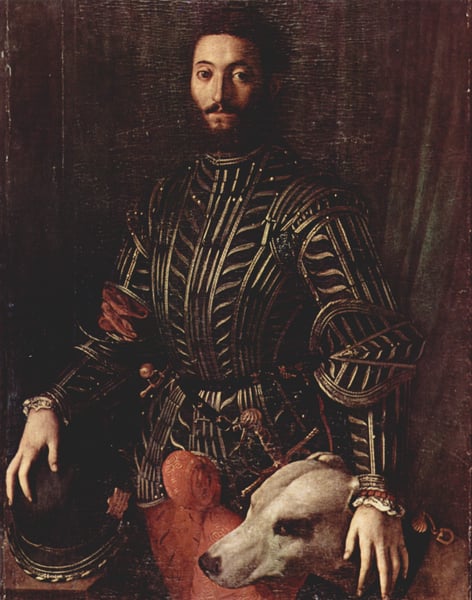
As a masterwork of Mannerism, Agnolo Bronzino’s Portrait of Guidubaldo della Rovere exemplifies the refined artificiality and intellectual elegance that define this late-Renaissance style. The portrait is not merely a likeness but a carefully constructed courtly ideal—characteristic of Bronzino’s approach to depicting Florentine nobility.
Significance within Mannerism:
- Elongation and elegance: The sitter’s slender, slightly elongated proportions and poised, self-contained posture reflect Mannerism’s departure from the naturalistic balance of High Renaissance portraiture. Guidubaldo’s graceful, almost sculptural pose suggests an air of cultivated detachment.
- Cool, polished palette: Bronzino’s signature use of cool silvers, icy blues, and pale flesh tones creates a surface of enamel-like perfection. This artificial color harmony intensifies the sense of opulence and emotional distance, inviting the viewer to admire the sitter’s status rather than his inner life.
- Detailed textures and surfaces: The meticulous rendering of armor, silk, and jewelry—each surface rendered with crisp precision—serves as a showcase of Mannerist virtuosity. Such attention to tactile luxury reinforces the duke’s wealth and authority, while the still, mask-like expression epitomizes the Mannerist ideal of sprezzatura: a studied nonchalance that conceals artistry.
Genre and context:
As a portrait, the work is highly significant for embodying the “court portrait” tradition of the 16th century, where the subject’s social position and intellectual refinement are prioritized over psychological depth. Guidubaldo’s direct but reserved gaze, the absence of narrative setting, and the emphasis on costly material details all serve to construct an image of aristocratic power filtered through the lens of Mannerist artifice.
In sum, this painting stands as a exemplary document of Mannerist portraiture—where reality is transformed into a sophisticated, decorative ideal, and the sitter becomes a luminous emblem of courtly grace.
Museum / Gallery
Görsel olarak benzer
İlişkili kompozisyon ve renk paletine sahip 20 eser
Charles V in Armour
Peter Paul Rubens
Retrato De Jean De Croÿ, Conde De Solre
Juan van der Hamen
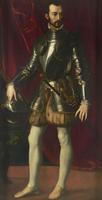
Francesco I De Medici
Alessandro Allori
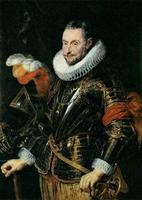
Portrait of Ambrogio Spinola
Peter Paul Rubens
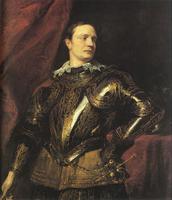
Portrait of a Young General
Anthony van Dyck
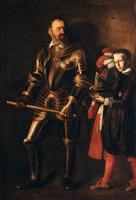
Portrait of Alof de Wignacourt and his Page
Caravaggio
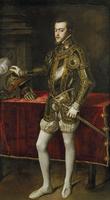
Philipp II, as Prince
Titian
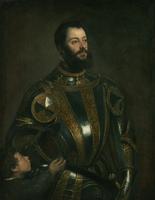
Portrait of Alfonso d`Avalos , in Armor with a Page
Titian
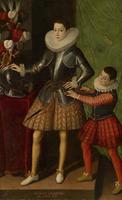
Portrait of Giuliano II Cesarini aged 14
Sofonisba Anguissola
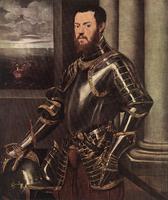
Man in Armour
Tintoretto
Portrait of Francesco I De' Medici
Alessandro Allori
Portrait of Stefano IV Colonna
Agnolo Bronzino
Portrait of a Man in a Gold Decorated Suit of Armour
Tintoretto
William III (1650–1702)
Willem Wissing
Portrait of a Young Bearded Man
Tintoretto
Retrato de Francisco II della Rovere
Federico Barocci
Portrait of Cosimo I de' Medici
Agnolo Bronzino
Alof of Vignancourt (after Caravaggio)
Fernando Botero
Sir John Drake
Edward Bower
Portrait Of John VIII, Count Of Nassau-siegen
Anthony van Dyck