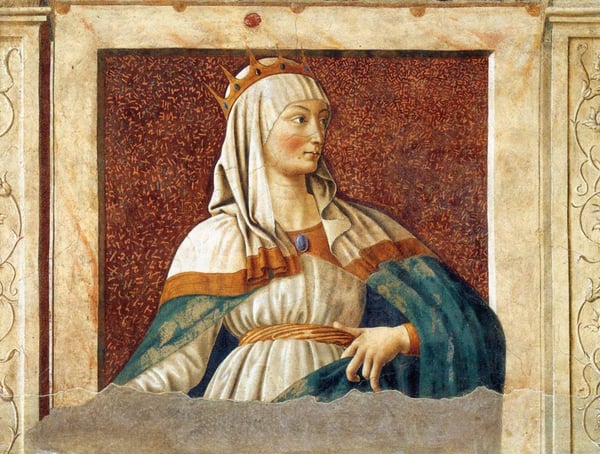
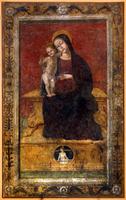
Based solely on the provided facts, the significance of "Queen Esther" by Andrea del Castagno as an Early Renaissance religious painting can be analyzed through the lens of period-defining innovations.
As an Early Renaissance work, this painting is significant for its departure from the flat, symbolic styles of the preceding Gothic and Byzantine eras. Castagno’s treatment of the religious subject matter likely emphasizes humanism—placing a biblical figure like Queen Esther in a more naturalistic, three-dimensional world. The painting would demonstrate a focus on anatomical accuracy and spatial depth, key concerns of the period that allowed religious narratives to feel more immediate and psychologically engaging.
Furthermore, within the religious genre, Castagno’s choice to depict Queen Esther—a heroic and decisive female figure from the Old Testament—reflects the Renaissance interest in individual character and moral strength. The artwork is significant for how it translates a sacred story into a scene of dramatic human interaction, using the period’s newly mastered techniques (such as chiaroscuro and linear perspective) to elevate the viewer’s emotional and spiritual connection. The painting thus stands as a prime example of how Early Renaissance art redefined religious iconography through a lens of naturalism and human dignity.